If you’ve spent any time on the internet, you’ve probably landed on a forum.
Maybe it was a Reddit thread answering a question Google couldn’t.
Maybe it was a Stack Overflow post that saved your project at 2 a.m.
Or maybe it was a niche community where people who share your obscure hobby actually get it.
Discussion forums have powered online communities since the earliest days of the web. And while social media has grabbed the spotlight, forums haven’t gone anywhere.
In fact, they’re evolving. Today’s forums are sleeker, smarter, and more integrated than ever, powering everything from customer support to course communities to brand advocacy programs.
This guide covers what discussion forums are, why they still matter, and where to build one if you’re ready to start your own.
What Is a Discussion Forum?
A discussion forum is an online platform where people hold conversations through posted messages. Unlike real-time chat, forums are asynchronous, you post a question or comment, and others respond when they can. Those conversations are organized into threads, archived, and searchable.
Here are the key terms you’ll encounter:
- Thread: A single conversation started by one post and followed by replies.
- Post: An individual message within a thread.
- Subforum/Category: A section dedicated to a specific topic within the larger forum.
- Moderator: Someone responsible for enforcing community guidelines and keeping discussions productive.
How forums differ from chat and social media:
Chat platforms like Slack and Discord are built for real-time conversation. Messages flow fast and disappear into the scroll. Great for quick exchanges, but terrible for building searchable knowledge.
Social media platforms like Facebook Groups offer reach but come with trade-offs: algorithm-controlled visibility, limited ownership of your audience, and ads competing for attention.
Forums sit in the middle. They’re slower and more deliberate than chat, but conversations stick around. They’re searchable, organized, and owned by you, not an algorithm.
Different Types of Discussion Forums
Not all forums serve the same purpose. Here’s how they break down:
Public vs. Private Public forums are open to anyone. Think Reddit or Stack Overflow—anyone can browse, and most can participate. Private forums require membership or approval, making them ideal for paid communities, internal teams, or exclusive groups.
Niche vs. General Interest Niche forums focus on specific topics: photography gear, language learning, indie game development. General interest forums cover broader ground, often organized into subforums by category.
Standalone vs. Embedded Some forums exist on their own as the primary destination. Others are embedded within larger platforms, like a discussion space inside a course or membership site. This embedded model is increasingly popular for creators who want community built into their learning experience.
Support Forums vs. Engagement Forums Support forums are built to answer questions and solve problems. Engagement forums prioritize connection, discussion, and relationship-building. Many communities blend both.
Benefits of Discussion Forums For Businesses And Communities
Forums deliver value in ways that chat and social media simply can’t match.
For Businesses:
Reduce support costs through peer-to-peer answers. When customers help each other, your support team handles fewer tickets. A well-maintained forum becomes a self-service knowledge base where common questions get answered without staff involvement.
Collect product feedback directly from users. Forums give you a window into what your customers actually think. Feature requests, complaints, and suggestions surface naturally in discussions—no surveys required.
Build SEO through user-generated content. Every thread is a page. Every answer is content. Forums generate a steady stream of indexable, keyword-rich material that drives organic traffic over time.
Turn customers into advocates. Active forum members often become your most loyal fans. They answer questions, defend your brand, and recruit others, all because they feel ownership in the community.
Marc Benioff, CEO of Salesforce, puts it plainly:
The future of communicating with customers rests in engaging with them through every possible channel. Customers are discussing a company’s products and brand in real time. Companies need to join the conversation.
HP discovered just how valuable that conversation can be. Their support forum handles 20% of global customer care requests and delivers $50 million in annual ROI. The forum hosts over 500 million posts, serves 40 million customers, and runs with 230 HP experts alongside 100,000 engaged community members. The kicker? 95% of the content comes from customers themselves.
For Communities and Courses:
Create belonging and connection. Forums give members a home base. A place to introduce themselves, share wins, ask for help, and build relationships that extend beyond any single course or event.
Enable peer-to-peer learning. The best insights often come from fellow learners, not instructors. Forums create space for members to teach each other, share resources, and compare notes.
Build searchable knowledge over time. Unlike chat, forum conversations don’t disappear. A question answered today helps someone searching for the same answer a year from now.
Keep engagement alive between live sessions. For cohort-based courses or membership communities, forums fill the gaps between calls, workshops, and events. They keep momentum going when you’re not live.
Discussion Forums vs Other Communication Formats
Not all community platforms serve the same purpose. The right choice depends on what you’re building and what outcomes matter most.
Forums
Forums excel at building lasting, searchable knowledge through asynchronous conversations. A question posted today remains discoverable for years, turning every answered thread into a resource for future members. This permanence creates compounding value and serious SEO benefits: Ubuntu’s forums have attracted over 1.8 million members, with millions more finding answers through Google searches. Stack Overflow built an entire business on this model, ranking for virtually every programming question imaginable.
The trade-off is speed. Forums move slower than real-time chat and require consistent moderation. But for brands willing to invest, the payoff is substantial: HP’s support forum handles 20% of global customer care and delivers $50 million in annual ROI.
Forums work best for: customer support communities (HP, Autodesk), knowledge-sharing platforms (Stack Overflow, Reddit), online course and membership communities (BuddyBoss, Coursera), software user communities (Ubuntu, WordPress), and professional networks where searchable expertise matters.
Chat Platforms (Slack, Discord)
Chat platforms thrive on immediacy. Questions get answered in minutes, creating energy that forums can’t match. Midjourney built its entire 15-million-member community on Discord, where users share prompts, showcase creations, and help newcomers in real time.
The downside is impermanence. Messages vanish in the scroll within hours, and valuable insights get buried forever. The “always-on” culture can also exhaust members and moderators alike. Many Slack communities, including some run by Zapier and Buffer, have scaled back because the maintenance burden outweighed the benefits.
Chat works best for: gaming communities (Discord servers for games like Valorant or Minecraft), creator fan bases (YouTuber and streamer communities), real-time collaboration teams, crypto and Web3 projects, and casual interest groups where quick interaction matters more than lasting content.
Social Groups (Facebook, LinkedIn)
Social groups offer the fastest path to an active community. Zero technical setup, built-in audiences, and familiar interfaces remove nearly every barrier. Peloton’s Facebook community has over 400,000 members sharing workout wins and motivating each other.
The fundamental problem is ownership. Algorithms control who sees your posts, and reach can vanish overnight. Facebook’s 2018 algorithm update devastated brand communities that spent years building engaged groups. You don’t own the data, ads compete for attention, and the platform’s priorities will never align with yours. Sephora recognized this and built their own Beauty Insider Community, giving them full control over 6 million members and direct access to customer insights.
Social groups work best for: local communities and meetup groups, hobbyist communities (gardening, cooking, fitness), early-stage communities testing demand, brand fan pages where quick launch matters more than long-term control, and professional networking (LinkedIn industry groups).
Here’s What Successful Forums Look Like
Forums aren’t a relic of the past. Some of the most valuable communities on the internet still run on the forum model.
Reddit, with over 100,000 active communities (subreddits) covering virtually every topic imaginable, Reddit proves that the forum format scales. From r/personalfinance to r/skincareaddiction, subreddits have become go-to resources for millions of people seeking advice, recommendations, and connection.
Stack Overflow The developer Q&A powerhouse has over 100 million users and 23 million questions answered. Stack Overflow’s strict moderation and voting system surface the best answers fast, making it an essential resource for programmers worldwide. According to their own data, 81% of the global developer population visits Stack Overflow weekly.
Ubuntu Forums One of the largest open-source support communities, Ubuntu Forums has helped millions of Linux users troubleshoot problems, learn new skills, and contribute back to the community. It’s a testament to how forums can power peer-to-peer support at scale.
Sephora Beauty Insider Community With roughly 6 million members, Sephora’s community forum lets beauty enthusiasts share tips, ask questions, post photos, and discuss products. It’s a masterclass in using forums to build brand loyalty and gather authentic user-generated content.
Adobe Community Adobe runs one of the largest branded support forums, where users help each other navigate complex creative software. By enabling peer support, Adobe reduces ticket volume while building goodwill among its user base.
What to Look for in a Forum Platform
If you’re ready to build your own forum, here’s what matters:
Customization and branding: Your forum should look and feel like yours. Look for platforms that let you customize colors, logos, layouts, and domains.
Moderation tools: Healthy communities need guardrails. Strong moderation features—spam filters, flagging, user permissions, and content approval workflows, making management easier.
Mobile experience: Most users will access your forum from their phones at least some of the time. A clunky mobile experience kills engagement.
Integration with courses or LMS: If you’re running a course or membership, your forum should integrate seamlessly with your learning platform. Separate logins and disconnected experiences create friction.
Scalability: What works for 100 members might break at 10,000. Choose a platform that can grow with you.
Ownership of your data: You should be able to export your content and member data. If the platform disappears tomorrow, your community shouldn’t disappear with it.
Best Community Building Platforms With Discussion Forums
Here are four solid options, each with different strengths:
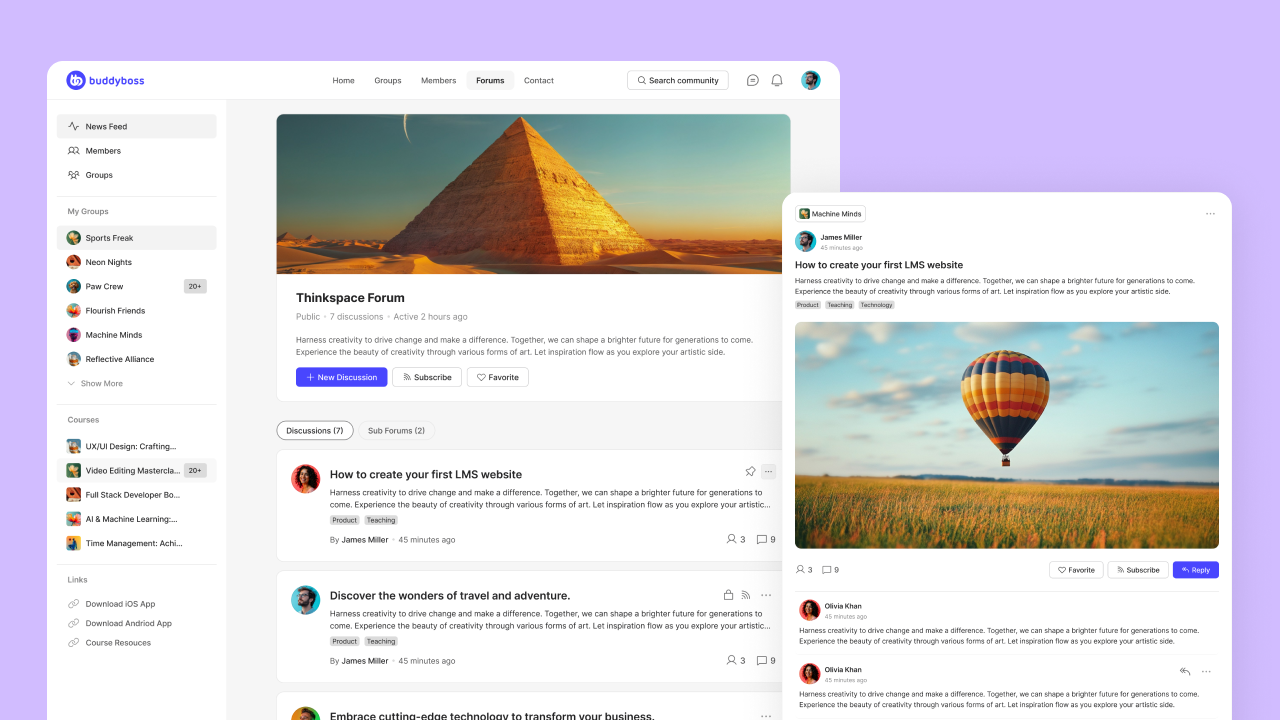
BuddyBoss Built on WordPress, BuddyBoss combines forums with full social community features: activity feeds, groups, member profiles, and messaging. It integrates natively with LearnDash and other LMS plugins, making it ideal for course creators who want discussion built into their learning experience. You own everything and can customize freely.
Discourse Open-source and modern, Discourse powers over 3,000 communities including some of the biggest names in tech. Founded by Stack Overflow co-founder Jeff Atwood, it’s built for civilized discussion with smart features like trust levels, real-time updates, and robust moderation. Free to self-host or available as a managed service.
Vanilla Forums Now part of Higher Logic, Vanilla is enterprise-ready forum software with gamification, Q&A features, and strong analytics. It’s popular with larger organizations that need scalability and integrations with existing business tools.
XenForo A traditional forum platform with modern features. XenForo is self-hosted and highly customizable, popular with gaming communities and hobbyist groups who want full control over their setup.
Build Your Own Discussion Forum with BuddyBoss
Forums create lasting value: searchable knowledge, reduced support costs, and real community that keeps members coming back. The question isn’t whether forums still matter, it’s where you’ll build yours.
If you want full control over your community, BuddyBoss gives you everything you need: forums, groups, member profiles, activity feeds, gamification and native LMS integration, all on WordPress, all under your brand. No renting someone else’s platform. No algorithm deciding who sees your content. Just your community, your way.
Try BuddyBoss free for 14 days and build your first forum →


 Article