Pricing your online course correctly is the difference between $500/month and $5,000/month in revenue. Most course creators charge between $97 and $2,997, but the right price depends on your transformation, market positioning, and delivery format.
I watched a course creator triple her revenue by raising her price from $497 to $1,497. Not by adding more content. Not by running better ads. Just by changing one number on her sales page.
That single decision transformed who bought her course. The $497 buyers consumed content passively and rarely implemented. The $1,497 buyers showed up to every call, did the work, and got results worth sharing.
Pricing your online course incorrectly can sabotage your business before you make your first sale. Set it too low and you attract tire-kickers who never complete the material. Set it too high without proper positioning and your sales page becomes a ghost town.
This online course pricing guide shows you exactly how to calculate your course price using proven frameworks
What’s Changed in 2026 (Why It Matters for Your Online Course Pricing)
Before diving into pricing strategies, understanding these shifts is essential for online course pricing in 2026. The online course market has shifted dramatically, and these changes directly affect how you should price. Let’s break down each trend.
The market has matured significantly. The global e-learning market hit $325 billion in 2025 and is projected to reach $400 billion by 2026. That’s both good news and a challenge. More buyers exist than ever, but they’ve also become more sophisticated. They’ve purchased courses before. They know the difference between a $47 PDF and a $2,000 transformation program.
AI has changed production expectations. AI tools now reduce course creation time by 50%, according to Gartner’s 2024 research. About 80% of course creators use AI for content creation. This means production quality alone no longer justifies premium course pricing. Your unique perspective and transformation methodology matter more.
Cohort-based courses are commanding premiums. Self-paced courses still dominate by volume, but cohort-based programs with live components see completion rates of 85-90% compared to roughly 10-15% for self-paced alternatives. Platforms like Maven report programs priced between $800 and $2,500 performing strongly, with some flagship courses like Ali Abdaal’s Part-Time YouTuber Accelerator charging $4,995 and generating over $1.5 million in nine months.
Subscription fatigue is real. While the e-learning subscription market is projected to hit $50 billion by 2026, individual creators are finding that one-time purchases often convert better than recurring models. Buyers are exhausted from managing dozens of subscriptions. They’re increasingly willing to pay more upfront for lifetime access rather than commit to another monthly fee.
Credentials matter more. About 40% of employers now recognize digital certificates as legitimate alternatives to degrees. This shifts how you can position and price skill-based courses, especially in professional development niches.
These trends shape everything that follows. Keep them in mind as we work through the pricing strategies.
The Pricing Fundamentals Most Creators Get Wrong
These three online course pricing mistakes cost creators thousands in lost revenue. Here’s what to do instead.
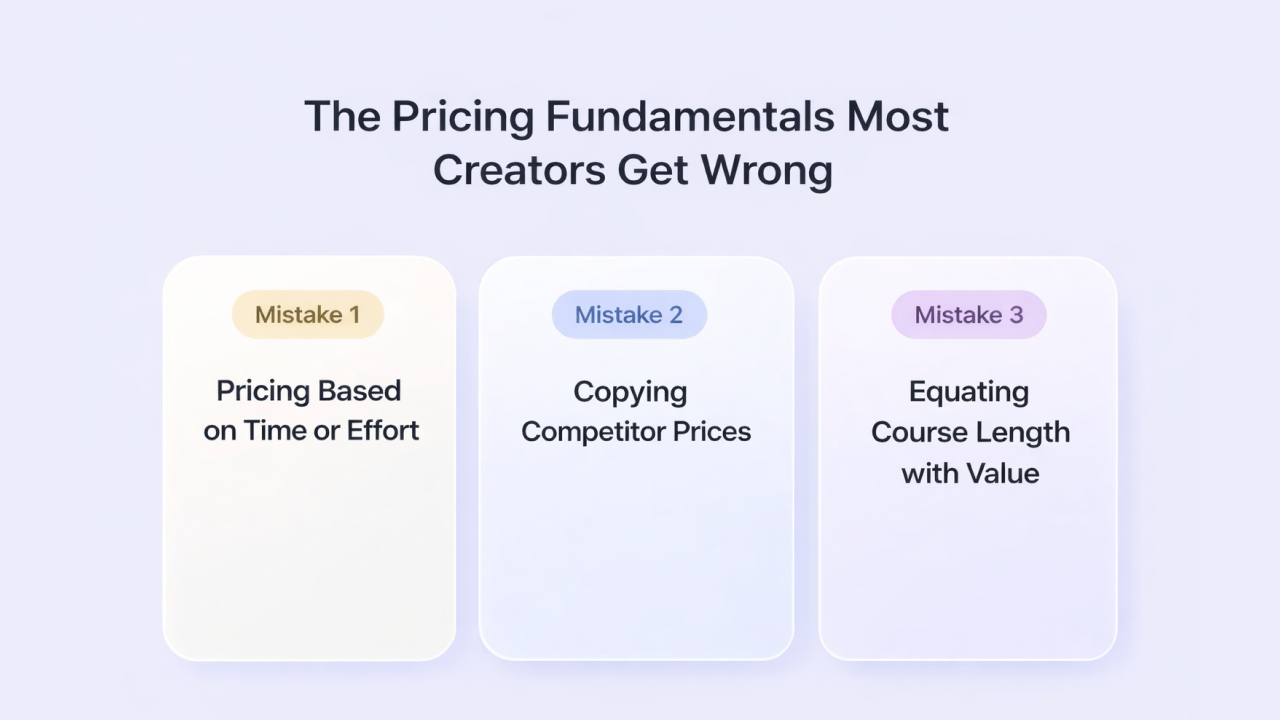
Mistake 1: Pricing Based on Time or Effort
Your course took 200 hours to create. That’s completely irrelevant to what you should charge. Buyers don’t care about your hours. They care about their transformation.
A course that teaches someone to land their first $5,000 freelance client in 30 days can command $500+ easily. A course that took twice as long to create but only teaches a hobby skill might struggle at $97. The input doesn’t determine the price. The output does.
Mistake 2: Copying Competitor Prices
I understand the instinct. You see a similar course at $297, so you price yours at $247 to undercut them. This approach fails for two reasons.
First, you don’t know if that competitor’s price actually works. They might be struggling. They might have a completely different business model where the course is a lead generator for high-ticket coaching.
Second, competing on price is a race to the bottom. There’s always someone willing to go lower. The customers who buy purely on price are also the most likely to request refunds, leave negative reviews, and never actually complete the material.
Mistake 3: Equating Course Length with Value
A 40-hour course is not automatically worth more than a 4-hour course. In fact, longer courses often signal poor instructional design, not greater value.
If you can teach someone to achieve a specific result in 4 hours, don’t pad it to 20 hours to justify a higher price. Buyers increasingly value efficiency. They want the fastest path to their goal, not the most comprehensive tour of everything tangentially related to their problem.
That said, expectations matter. If you charge $500 for 30 minutes of content, buyers will feel shortchanged regardless of the value. A reasonable benchmark: if you’re charging $500+, aim for at least 3-5 hours of core content.
The Price-Psychology Connection
Here’s something counterintuitive that research consistently supports: higher prices often lead to better outcomes.
When someone pays $4,997 for a course, they show up differently than someone who paid $47. The higher investment creates psychological commitment. They’ve put enough skin in the game that they’re motivated to do the work and get results.
One leadership development course tested this directly. At $497, it attracted hobbyists who rarely completed assignments. When repriced at $4,997 with identical content, it attracted serious professionals who implemented immediately and achieved measurable results.
The price didn’t just change revenue. It changed who bought and how seriously they engaged.
The Four Pricing Tiers (With Real Numbers)
Online courses generally fall into four price tiers. Each serves a different purpose in your business.
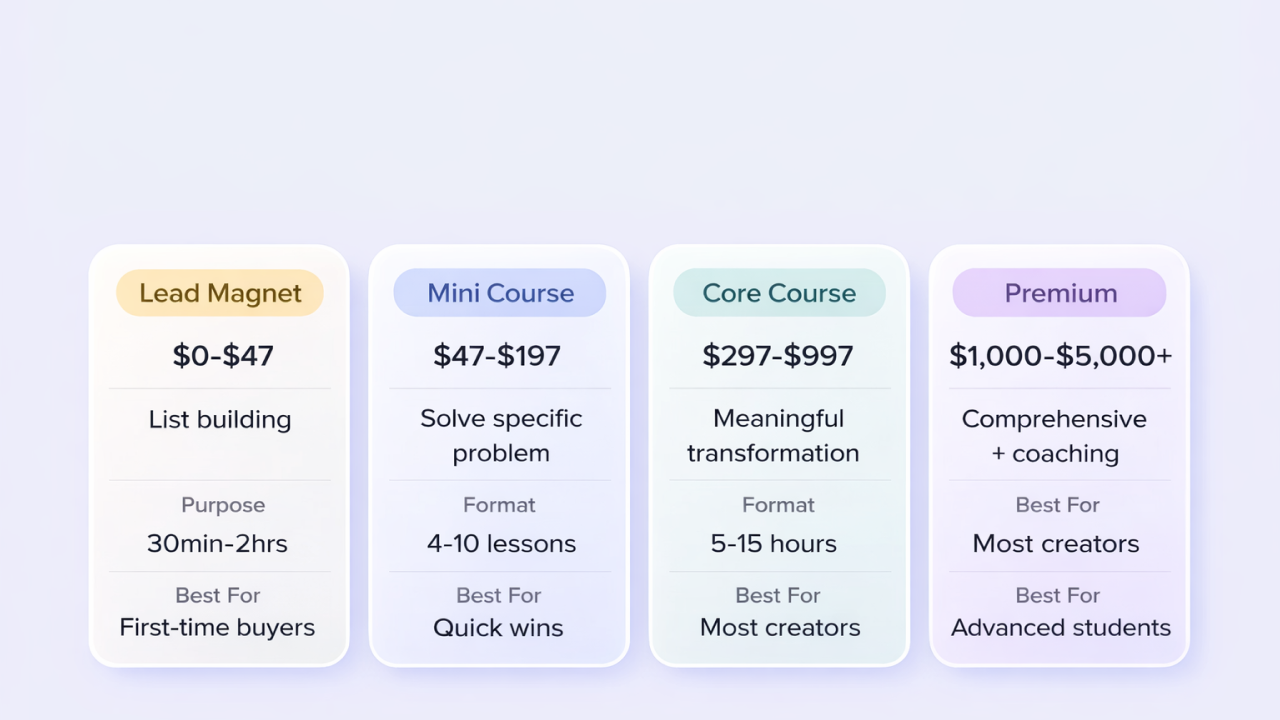
| Tier | Price Range | Purpose | Format | Best For |
| Lead Magnet | $0-$47 | List building | 30min-2hrs | First-time buyers |
| Mini Course | $47-$197 | Solve specific problem | 4-10 lessons | Quick wins |
| Core Course | $297-$997 | Meaningful transformation | 5-15 hours | Most creators |
| Premium | $1,000-$5,000+ | Comprehensive + coaching | Full curriculum + live | Advanced students |
Tier 1: Lead Magnets and Tripwires ($0-$47)
Purpose: Build your email list, demonstrate expertise, create first-time buyers
Format: Mini-courses, email courses, short video series (typically 30 minutes to 2 hours)
Example: Amy Porterfield, an online marketing expert, regularly runs free 5-day challenges like her “List Builders Lab Challenge.” Participants receive daily video lessons and worksheets via email teaching specific email marketing strategies.
At the end of the challenge, graduates receive an offer for her flagship course “Digital Course Academy” priced at $1,997.
This free challenge has helped her build an email list of over 300,000 subscribers and generated millions in course sales. The free challenge proves her teaching ability, delivers immediate value, and naturally positions the paid course as the next logical step.
Free or low-cost courses work best as entry points, not primary revenue drivers. Don’t expect to build a sustainable business at this tier alone. The real value lies in converting 5-10% of free participants into paying customers for higher-priced offerings.
Tier 2: Mini Courses ($47-$197)
Purpose: Solve a specific, narrow problem quickly
Format: 4-10 video lessons, each under 15 minutes, with basic supporting materials
Example: Graham Cochrane from The Recording Revolution sells focused mini-courses on specific music production skills. His course “EQ Strategies: Your Action Plan for Better Mixes” sells for $97 and teaches one specific skill—how to use EQ effectively in audio mixing, in under 3 hours.
The course includes 12 video lessons (each 10-15 minutes), downloadable cheat sheets, and before/after audio examples. It solves one narrow problem for home studio owners who struggle with muddy mixes. This focused approach has helped him sell thousands of copies while building trust for his higher-priced offerings like his $497 “Compression Breakthroughs” and $997 “Mix With Us” membership.
This tier works well for impulse purchases and testing market demand. If your $97 course sells consistently, you have validation to develop a more comprehensive offer at a higher price point. Graham used this exact strategy, his early mini-courses validated demand before he created more expensive, comprehensive programs.
Tier 3: Core Courses ($297-$997)
Purpose: Deliver meaningful transformation on a defined topic
Format: 4-8 modules covering a complete methodology, typically 5-15 hours of content, with worksheets, templates, and community access
Example: Vanessa Lau’s “YouTube Starter Kit” sells for $497 and teaches content creators how to launch and grow a YouTube channel. It includes 6 modules covering strategy, filming, editing, SEO, and monetization, plus video templates, scriptwriting frameworks, and access to a private community. Students get a complete system to go from zero to their first 1,000 subscribers and monetized channel.
This is the sweet spot for most creators. You’re charging enough to attract committed students while keeping the barrier to entry reasonable. If you’re launching your first substantial course, start here.
Tier 4: Premium and Flagship Programs ($1,000-$5,000+)
Purpose: Comprehensive transformation with high-touch support
Format: Full curriculum plus live calls, coaching, personalized feedback, certification, or done-with-you elements
Example: Marie Forleo’s “B-School” is a flagship 8-week business training program priced at $2,000. It includes comprehensive video modules, live Q&A calls with Marie, guest expert trainings, personalized feedback on business plans, a private community of 75,000+ entrepreneurs, and lifetime access to all updates. The program runs as annual cohorts with specific start dates, creating urgency and peer accountability. B-School has generated over $100 million in revenue since launching in 2010.
Premium pricing requires more than just content. You need live components, community, coaching, or certification to justify the investment. The course content itself might represent only 30-40% of the total value at this tier. The real value comes from access, accountability, and transformation.
Choose Your Pricing Model
Beyond the price itself, you need to decide how you’ll collect that payment.
One-Time Payment
Best for: Evergreen courses, results-focused programs, first-time course creators
Students pay once, get lifetime access. This is the simplest model and often converts best because the transaction is easy to understand. No ongoing commitment, no fear of being locked in.
The downside: you need to continuously acquire new customers to maintain revenue. Each sale is a standalone transaction rather than recurring income.
Pro tip: One-time payments build your customer list faster. Each buyer becomes a potential purchaser for your next course, coaching program, or premium offering. The lifetime value of a customer extends far beyond their initial purchase.
Subscription or Membership
Best for: Continuously updated content, community-focused programs, ongoing skill development
Students pay monthly or annually for access to your course library and ongoing content. This creates predictable recurring revenue, which makes business planning easier.
The reality check: subscriptions require constant content creation to justify ongoing payments. Average membership retention tends to be 4-6 billing cycles, meaning a $50/month member is actually worth roughly $200-300 in total revenue, not $600/year.
Subscriptions also demand more customer support. People expect immediate responses when they’re paying you every month.
Payment Plans
Best for: Higher-priced courses ($500+) where the upfront cost creates friction
Offer 3-6 monthly payments as an alternative to paying in full. This increases accessibility without permanently lowering your price.
Example: A $1,497 course might offer 3 payments of $547, totaling $1,641. The slight premium on the payment plan compensates for the added risk (some payments will fail) and encourages buyers who can afford it to pay in full.
Warning: Payment plans are not subscriptions. Once the payment plan completes, the student has lifetime access. Don’t structure it as “$47/month as long as you want access”, that’s a membership model with different expectations.
Cohort-Based Pricing
Best for: Courses with live components, programs where peer accountability drives results
Students enroll during specific windows and progress through the material together with live sessions, group work, and structured deadlines.
Cohort courses typically command 2-3x the price of equivalent self-paced content because the completion rates are dramatically higher. When students know they’re accountable to peers and have live interaction with the instructor, they engage differently.
Example: A self-paced marketing course might sell for $500. The same content delivered as an 8-week cohort with weekly live Q&As and a private Slack community could sell for $1,500.
The Value Equation: Calculate Your Price
Here’s the framework I use to determine a starting price.
The 10x Value Formula
Your online course price should represent roughly 10% of the value it delivers. If your course helps someone land a $50,000 job, $5,000 is a reasonable price. If it saves them 100 hours of trial and error worth $5,000 in their time, $500 makes sense.
Step 1: Identify the tangible outcome your course delivers. Be specific. Not “learn marketing” but “launch your first profitable Facebook ad campaign.”
Step 2: Quantify that outcome in dollars. How much money will they make, save, or avoid losing by achieving this result?
Step 3: Divide by 10. That’s your starting price point.
Example: Your course teaches freelancers to raise their rates. If the average student goes from $3,000/month to $5,000/month, that’s $24,000 in additional annual income. A $2,400 price point represents 10x value. Even $1,200 offers 20x return, making it an obvious investment.
The Alternative Cost Method
What would someone pay to achieve this result through other means?
- Hiring a consultant or coach one-on-one
- Taking a university course or certification program
- Figuring it out through trial and error (time cost)
- Buying and implementing software or tools
If one-on-one coaching costs $200/hour and would take 20 hours to achieve the same result, the alternative cost is $4,000. Your course at $997 represents significant savings while still being substantial enough to attract committed buyers.
Stacking Value: How Bonuses and Support Shift Pricing
The core course content establishes your baseline. What you stack on top determines how high you can price.
Templates and swipe files: Add $50-200 in perceived value. Buyers love done-for-you resources that shortcut implementation.
Community access: Add $100-500 in perceived value. A private space to ask questions and connect with peers is often worth more than the course itself.
Live calls or coaching: Add $200-1,000+ in perceived value. Any live interaction with you justifies significant price increases.
Certification: Add $200-500 in perceived value. Official recognition that students can display on LinkedIn or their website.
A $497 course with templates, community, and monthly Q&A calls can become a $1,497 program. The content might be identical, but the total value delivered is significantly higher.
Psychological Pricing That Actually Works
Small pricing decisions can significantly impact conversion rates. Here’s what research and testing actually supports.
The Left-Digit Effect
$997 feels meaningfully cheaper than $1,000, even though the difference is just $3. Our brains process the leftmost digit first, so $997 registers in the “hundreds” while $1,000 registers in the “thousands.”
Use this for entry-level and mid-tier courses where price sensitivity is higher: $97, $197, $297, $497, $997.
Prestige Pricing
Round numbers signal confidence and quality. Premium courses and high-ticket programs often use $2,000 rather than $1,997 precisely because it feels more substantial and less “salesy.”
If you’re positioning as the premium option in your market, round numbers reinforce that positioning.
Anchoring with Tiers
Offering a single price forces a binary decision: buy or don’t buy. Offering tiers changes the question to: which tier should I buy?
Example structure:
- Basic ($497): Course content only
- Standard ($997): Course + templates + community
- Premium ($1,997): Course + templates + community + coaching calls
Most buyers select the middle option. It feels like the sensible choice: not the bare minimum, not the extravagant maximum. Many who would have balked at $997 as a single price will select it when positioned between $497 and $1,997.
Bonuses Beat Discounts
Instead of offering 20% off your $997 course, offer “free bonuses worth $497.” Even if the buyer might save more with the discount, the bonus feels like getting something extra rather than the course being worth less.
Discounts erode perceived value. Bonuses enhance it.
Online Course Launch Pricing vs Evergreen Pricing
How you price during launch differs from how you price for ongoing sales.
Beta and Founding Member Pricing
Your first launch is for learning, not maximum revenue. Consider offering a significant discount (40-60% off your planned price) to early buyers in exchange for their feedback and testimonials.
Example: “Join the founding cohort at $297 (regular price $497). As a founding member, you’ll get direct access to me for feedback, and I’ll use your input to make the course even better.”
This framing positions the discount as an exchange rather than a sign that your course is worth less. Founders get a deal. Future students pay full price.
Early Bird Strategies
For subsequent launches, early bird pricing creates urgency without permanently devaluing your course.
- 72-hour early bird: 15-20% off for the first 72 hours after launch
- First 50 buyers: Special rate for a limited number of enrollments
- Launch week bonuses: Full price, but extra bonuses for those who enroll during launch
The key: make every discount feel earned and time-limited. “This price is available because you’re part of my audience” works. Random 50% off coupons destroy credibility.
When and How to Raise Prices
Raise your price when:
- Your conversion rate exceeds 5% consistently (too high often means you’re underpriced)
- You’ve added significant value (new modules, better bonuses, community)
- Student results have improved and you have testimonials to prove it
- You’re attracting buyers who aren’t serious or who request refunds frequently
How to communicate price increases:
Be direct. “On [date], the price of [course] is increasing from $497 to $697 because of [specific additions/improvements]. If you’ve been considering enrolling, now is the time.”
This approach is honest, creates legitimate urgency, and often drives a wave of sales from fence-sitters.
Evergreen Pricing: Handle Discounts Carefully
Once you’re selling continuously rather than in launches, resist the urge to discount constantly.
I’ve seen creators run “limited time 50% off” sales so frequently that no one ever pays full price. This trains your audience to wait for the next sale and signals that your full price is inflated.
If you discount evergreen courses, do it rarely (1-2 times per year), with legitimate reasons (Black Friday, course anniversary), and for limited periods.
Host courses, build community, keep profits. All with BuddyBoss.
Testing and Optimizing Your Price
You have to understand that pricing is not a one-time decision. It’s an ongoing experiment.
A/B Testing Methodology
If you have sufficient traffic, test price points directly. Send half your audience to a $497 sales page and half to a $697 page. Measure total revenue, not just conversion rate.
Example: $497 converts at 3% on 1,000 visitors = 30 sales = $14,910. $697 converts at 2% on 1,000 visitors = 20 sales = $13,940. The lower price wins on revenue despite higher conversion at the higher price point.
But if $697 converts at 2.5%? That’s $17,425 in revenue. Small differences in conversion at higher prices can significantly impact total revenue.
Signals That Your Price Is Wrong
You might be priced too low if:
Conversion rates are unusually high (8%+) but revenue is still modest
Students don’t complete the course or take it seriously
You’re attracting buyers who are problematic (complaints, refunds, neediness)
People frequently say “I would have paid more”
You might be priced too high if:
Conversion rates are very low despite strong traffic
Price objections dominate your sales conversations
You’re unable to articulate the value clearly enough to justify the investment
Your target audience genuinely cannot afford your price (know your market)
Advanced Strategies
International and PPP Pricing
A $997 course is a different commitment in San Francisco than in Mumbai. Purchasing Power Parity (PPP) pricing adjusts your price based on the buyer’s location.
Many platforms now support automatic PPP discounts. You might offer 30-60% off for buyers in countries with lower purchasing power, expanding your reach without devaluing your course in primary markets.
The tradeoff: some buyers will use VPNs to access lower prices. Most won’t. The expanded audience usually more than compensates for any lost revenue from gaming.
The Product Ladder
Your course shouldn’t exist in isolation. It’s part of a larger ecosystem.
Example ladder:
- Free: Email course on the fundamentals
- $97: Mini course solving one specific problem
- $497: Core course with complete methodology
- $2,000: Premium cohort program with coaching
- $5,000+: One-on-one coaching or consulting
Each rung builds trust and demonstrates value, making the next purchase easier. Someone who bought your $97 course and got results is far more likely to invest $497 in your next offering than a cold lead.
Common Pricing Mistakes (And How to Avoid Them)
- Constant discounting. Every sale trains your audience to wait for the next one. Use discounts sparingly and always with legitimate reasons.
- Pricing for your comfort, not your market. What feels “expensive” to you might be reasonable to your ideal customer. Your discomfort with higher prices can leave significant money on the table.
- Failing to communicate value. The price itself is rarely the problem. The real issue is usually a failure to articulate what the buyer gets and why it’s worth the investment.
- Analysis paralysis. Some creators delay launching for months because they’re “figuring out pricing.” Pick a reasonable starting point based on this guide and adjust from there. Real market feedback is worth more than endless theorizing.
- Ignoring your positioning. If everything else about your brand says “premium” but your course is $47, you create cognitive dissonance. Price should match your overall positioning.
- Not raising prices as you grow. Your first course might sell for $297. After 500 students, glowing testimonials, and refined content, that same course might deserve $597 or $997. Don’t let inertia keep you at your original price forever.
Your Pricing Action Plan
Here’s your step-by-step online course pricing action plan to implement everything we’ve covered.
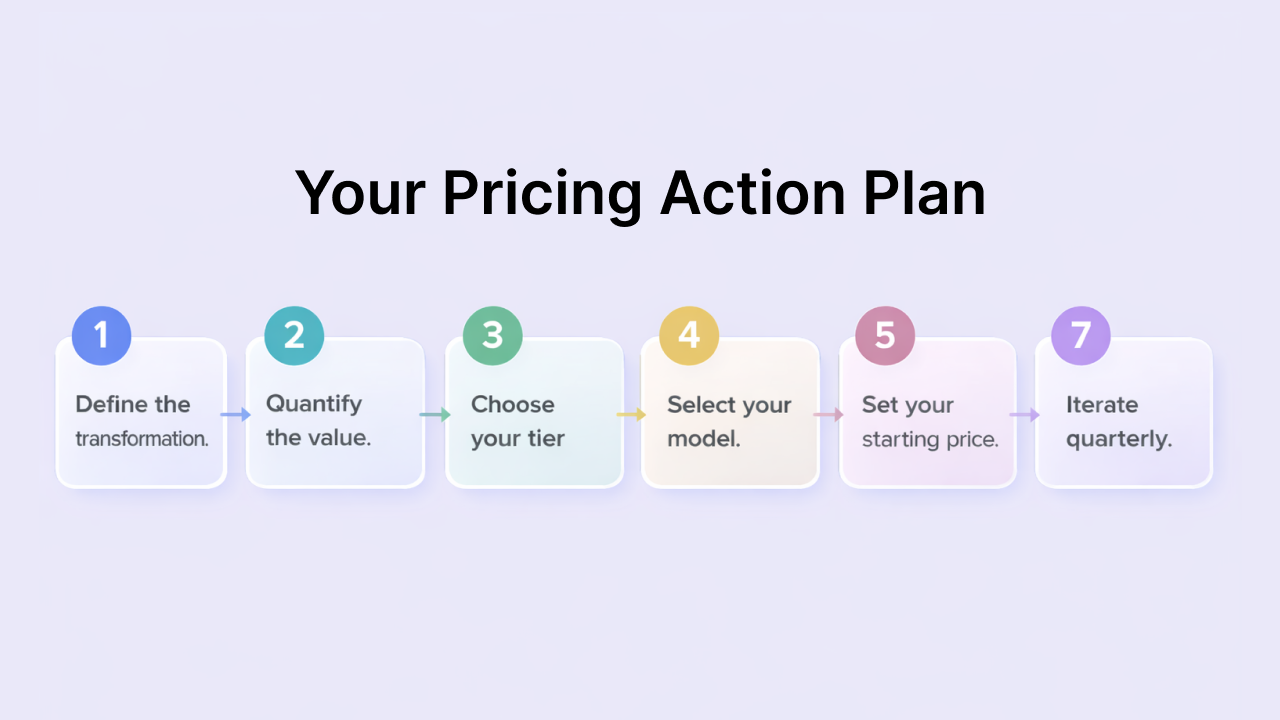
Step 1: Define the transformation. What specific outcome does your course deliver? Write it in one sentence.
Step 2: Quantify the value. What is that outcome worth in dollars? Consider money earned, saved, or time reclaimed.
Step 3: Choose your tier. Based on your content depth and delivery format, which tier fits? Mini course, core course, or premium program?
Step 4: Select your model. One-time payment, subscription, payment plan, or cohort-based? Match the model to how your content delivers value.
Step 5: Set your starting price. Use the 10x value formula as your starting point. Adjust based on alternative costs and value stacking.
Step 6: Launch and learn. Get your course in front of real buyers. Their behavior will tell you more than any theoretical framework.
Step 7: Iterate quarterly. Review your pricing every 90 days. Look at conversion rates, revenue, student quality, and completion rates. Adjust as needed.
Frequently Asked Questions
How much should I charge for my online course?
Charge based on the value you deliver, not creation time. Use the 10x value formula: if your course helps someone earn or save $5,000, charge around $500. Most successful courses range from $97 (mini-courses) to $997 (core courses) to $2,997+ (premium programs with coaching). The right price depends on the tangible outcome students achieve and how you deliver it (self-paced vs. cohort-based).
What is the average price of an online course?
The average online course price is $182, but this includes everything from $10 Udemy courses to $10,000 executive programs. More useful benchmarks: self-paced courses typically cost $100-$500, cohort-based programs with live components average $800-$2,500, and certification programs with coaching range from $1,500-$5,000+. Professional development courses command higher prices than hobby courses.
Should I offer payment plans for my course?
Yes, offer payment plans for courses priced above $500. They increase conversions by 15-30% without permanently lowering your price. Structure them as 3-6 monthly payments with a 10-15% premium over the full-pay price. For example, a $1,497 course could offer three payments of $547 (total $1,641). The premium compensates for processing fees and failed payments while encouraging upfront payment.
How do I know if my course is priced too high?
Your course is priced too high if conversion rates stay below 1% despite targeted traffic, price objections dominate sales conversations, and you can’t clearly articulate value justifying the investment. But don’t confuse “too high” with poor marketing. Test improving your sales page clarity, adding testimonials, and strengthening your value communication before dropping your price. Run an A/B test: if lowering the price 30% doesn’t improve total revenue, pricing wasn’t the problem.
What’s the difference between course tiers?
Course tiers differ in transformation scope and support level, not just length. Lead magnets ($0-$47) build trust with 30-minute to 2-hour content. Mini-courses ($47-$197) solve specific problems in under 5 hours. Core courses ($297-$997) deliver complete transformations with 5-15 hours plus community access. Premium programs ($1,000-$5,000+) add live coaching, certification, and personalized feedback. Choose the tier matching your audience’s needs and the transformation you deliver.
Is it better to charge a one-time fee or monthly subscription?
One-time fees convert 2-3x higher and work better for most creators because they’re simple and build your customer list faster. Subscriptions ($20-$100/month) only make sense if you continuously add new content, maintain an active community, or deliver ongoing skill development. Reality check: average subscription retention is 4-6 months, so a $50/month member generates $200-$300 total, not $600/year. Choose one-time for defined transformations, subscriptions for ongoing value.
Should I discount my course for launch or keep the price consistent?
Discount 40-60% for your first beta launch to gather testimonials, then use time-limited early-bird pricing (15-20% off) for future launches to create urgency. Once established, discount rarely—maximum twice yearly—to avoid training your audience to wait for sales. Position first discounts as exchanges: “Join as founding member at $297 (regular $497) in exchange for feedback.” After launch, raise prices as you add value rather than constantly discounting.
How often should I raise my course price?
Raise prices when conversion rates consistently exceed 5% (you’re underpriced), when you’ve added significant value like new modules or coaching, or when improved student results give you strong testimonials. Review pricing quarterly and increase by 20-40% annually as your offer matures. Communicate increases honestly: “On April 1st, [Course] increases from $497 to $647 due to [specific additions]. Enroll now at current pricing.”
Do cohort-based courses really justify 2-3x higher pricing?
Yes. Cohort courses achieve 85-90% completion rates versus 10-15% for self-paced, justifying premium pricing through better results. Students willingly pay $1,500 for an 8-week cohort over $500 for identical self-paced content because live accountability, peer interaction, and scheduled structure deliver measurable transformation. You’re not just charging more—you’re delivering dramatically better outcomes. Example: same marketing content sells for $497 self-paced or $1,497 as an 8-week cohort with weekly live calls.
What’s the biggest pricing mistake course creators make?
Pricing based on personal comfort level rather than actual value delivered. If $500 feels expensive to you but your course helps someone earn $10,000, you’re leaving money on the table and attracting uncommitted buyers. Other critical mistakes: constant discounting that trains audiences to wait for sales, competing on price instead of value, never raising prices as your offer improves, and pricing by content hours instead of transformation delivered. Fix it: Use the 10x value formula and test with real buyers.
Price Your Course Like You Mean It
Online course pricing is not just a number. It’s a statement about who your course is for, what it delivers, and how seriously you take your own expertise.
The creators I’ve seen succeed don’t obsess over finding the “perfect” price. They set a reasonable price based on clear thinking, launch, and iterate based on real data.
Your price will evolve. Your first course might be $297. Your fifth might be $2,997. That’s not inconsistency, it’s growth.
Start where you are. Price with confidence. Deliver more value than you charge for. Everything else follows from there.
Happy Growing!


 Article