













Online course sales crossed $400 billion globally in 2025, but the average solo course creator earns less than $10,000/year.
The difference between those who build real course businesses and those who don’t? Infrastructure.
WordPress gives you the same capabilities as Kajabi or Teachable with LMS, payment processing, community at a fraction of the cost, with full ownership of your content and student relationships.
If you’ve been wondering whether an online course WordPress setup can compete with the all-in-one platforms, the answer is yes and in most cases it outperforms them.
This guide walks you through every step: choosing your stack, planning your curriculum, building in WordPress, launching to your audience, and scaling with community and upsells.
Why WordPress for Online Courses in 2026
Before you choose a platform, understand what you’re choosing between. WordPress powers half of all websites on the internet. That market dominance exists for a reason: flexibility, ownership, and a plugin ecosystem that lets you build anything.
The cost case is overwhelming
Here’s what a professional course business costs on each platform annually:
| Platform | Annual Cost | Commission | Content Ownership |
|---|---|---|---|
| WordPress + BuddyBoss | $359–$599/yr | 0% (Stripe: 2.9% + $0.30) | Full, your server |
| Kajabi | $1,068–$4,788/yr | 0% | Platform-owned |
| Teachable | $468–$2,988/yr | 0–5% depending on plan | Platform-owned |
BuddyBoss Platform runs $299/yr. Add managed WordPress hosting — Cloudways, Kinsta, or WP Engine at $60–$300/yr and you’re looking at $359–$599/yr total. That’s up to $4,189/yr cheaper than Kajabi’s mid-tier plan, at equivalent capability.
Stripe charges 2.9% + $0.30 per transaction. That’s your only processing fee. No platform commission on top.
You own everything
When you build on WordPress, your content lives on your server. Your student email list is yours. Your course access logic, your community, your brand, all yours. If BuddyBoss shut down tomorrow (it won’t), you’d still have your WordPress install, your student data, and your content. That’s not true on Kajabi or Teachable.
Community drives completion
Students who participate in a community alongside their coursework complete at 3–5x higher rates than students who learn in isolation. BuddyBoss integrates the community directly with your courses, a meaningful structural advantage over LMS-only tools. See how this fits into a broader community monetization guide.
For context on the broader tooling landscape, the digital product creation tools overview covers how courses fit alongside other digital products.
Step 1: Choose Your Course Platform Stack
There’s no single right answer! Your best stack depends on budget, technical comfort, and how much LMS depth you need.
Option A: BuddyBoss Platform (Recommended for most creators)
BuddyBoss Platform at $299/yr is the all-in-one option: community (BuddyPress-based social features), membership management, and payment integration under one roof. You install one plugin, configure one dashboard, and you’re building.
Option B: LearnDash + BuddyBoss Platform
LearnDash ($199/yr) is one of the most mature LMS plugins on WordPress. Pair it with BuddyBoss ($299/yr) for community and membership features and you get deeper LMS capability at $498/yr total. This is the right choice if your courses are technically complex or if you’re migrating an established course business with specific LMS requirements.
Option C: TutorLMS or LifterLMS (free tiers) + BuddyBoss
Both TutorLMS and LifterLMS offer free tiers with solid core LMS functionality. Add BuddyBoss for community. This is the most budget-friendly path, though integration between the LMS and community layer is less seamless than Option A or B.
Hosting requirements
Whatever stack you choose, use managed WordPress hosting with at minimum 2GB RAM. Video streaming and real-time community features are resource-intensive. Recommended hosts: Cloudways (pay-as-you-go, developer-friendly), Kinsta (premium managed WP, excellent support), WP Engine (enterprise-grade, strict environment).
Step 2: Plan Your Course for Maximum Revenue
Technical setup is the easier half of this. Course architecture, which is how you structure and price your content determines whether students get results and whether you make money.
Start with transformation, not content
Work backward from the outcome your student will achieve. What problem are they solving? What skill will they have? What result can they credibly claim after completing your course? That transformation defines your course, not the hours of video you produce.
A practical planning sequence:
- Identify the transformation — one specific, measurable result
- Structure the journey — what steps does a student need to take in sequence?
- Create content — build the modules and lessons that execute those steps
- Set pricing — based on the value of the transformation, not content volume
- Plan the launch — more on this in Step 4
Course structure that works
Most effective courses follow a consistent pattern:
- 4–8 modules covering distinct phases of the journey
- 3–5 lessons per module — short enough to maintain momentum
- One quiz or assessment per module — reinforces learning, signals progress
Use drip scheduling to release modules weekly rather than giving students access to everything at once. Weekly releases maintain engagement, reduce overwhelm, and create natural touchpoints for community discussion.
Pricing frameworks
Price on transformation value, not content length.
| Course Type | Price Range | Example |
|---|---|---|
| Mini-course | $47–$97 | “Launch your first email list in 5 days” |
| Signature course | $297–$997 | “Build a 6-figure consulting practice” |
| Premium program | $1,000–$5,000 | Coaching + curriculum hybrid |
Example: if your course helps students build a community that earns $5,000/month, a $997 price tag represents less than one month’s ROI. Price the transformation, not the lesson count.
Content formats to include: video (primary delivery), written lesson summaries, downloadable resources (worksheets, templates, checklists), quizzes, and assignments. Video drives engagement; downloadables drive action.
Step 3: Build Your Course in WordPress
With your stack chosen and curriculum planned, it’s time to build. This section covers the BuddyBoss Platform path (Option A).
Setting up BuddyBoss LMS
The basic course build flow in BuddyBoss:
- Navigate to Courses in your WordPress dashboard
- Create your course — add title, description, and featured image
- Build your course structure: add sections (modules), then add lessons within each section
- Configure quizzes at the module level — set question types, passing scores, and retry logic
- Set enrollment options: open enrollment, payment-gated, or membership-restricted
Connecting payments
Connect Stripe through WooCommerce or BuddyBoss’s built-in payment settings. Set your course price, configure any coupons or limited-time pricing, and test the purchase flow before launching.
Linking courses to community
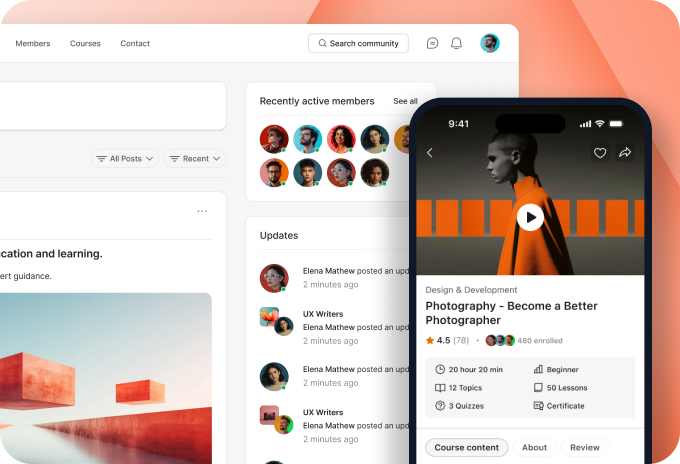
BuddyBoss and LearnDash can connect each course to a dedicated community group. When a student enrolls in your course, they’re automatically added to the corresponding group, giving them a space to ask questions, share progress, and engage with peers going through the same material.
Research shows that students who engage socially within an online course access significantly more course content than those who don’t with social learners completing between 50–100% of course steps compared to just 9–46% for non-social learners. That gap is what community-course integration is designed to close.
Content protection and free previews
Use membership levels to control who can access what. Gate paid content behind the appropriate membership or payment. Make 1–2 lessons in your first module available as free previews, this gives potential students a direct experience of your teaching before they buy.
Certificates and progress tracking
With LearnDash integrated into BuddyBoss, students get a dashboard showing exactly where they are in the curriculum, which lessons are complete, what’s next, and how far they’ve come.
Instructors can monitor completion rates across their entire student base from the same admin panel. Certificates, quizzes, and advanced progress tracking are all built into LearnDash, and with BuddyBoss, they integrate visually and functionally with your community BuddyBoss, so a completed certificate shows up on a member’s profile, visible to peers, adding a social layer to what’s usually a private milestone.
Step 4: Launch and Sell Your Course
A well-built course with no launch strategy earns nothing. Treat the launch as its own project with the same planning rigor you brought to the curriculum.
Pre-launch checklist
Before you open enrollment, run through this:
- Complete a test purchase — confirm the payment flow works end-to-end
- Verify email delivery — purchase confirmation, welcome sequence, drip notifications
- Mobile check — navigate the course, community, and checkout on a phone
- Student experience preview — create a test student account and walk through the full experience
- Check all lesson content is published or correctly scheduled
Launch sequence
A proven sequence for an online course to sell at launch:
- Email your list — announce with a limited-time founding price (20–30% below standard)
- Host a free webinar or workshop — deliver real value, pitch at the end
- Limited-time pricing window — 5–7 days drives urgency without feeling desperate
- Open enrollment — transition to standard pricing, keep selling
Your email list is your most valuable launch asset. If you’re building from zero, start list-building 60–90 days before your launch target.
Sales page fundamentals
Your sales page does the selling. Every element should serve that goal:
- Headline — state the transformation clearly
- Transformation promise — what they’ll be able to do after completing
- Curriculum breakdown — show the modules and what’s covered
- Social proof — testimonials, beta student results, your own credentials
- Pricing — clear, with value justification
- FAQ — address objections directly (see the FAQ section below for common ones)
- CTA — one clear action, repeated 2–3 times on the page
Email marketing for launching online courses
Use FluentCRM (WordPress-native, no monthly SaaS fee) or Mailchimp for your launch sequence and ongoing student engagement.
A basic launch sequence:
announcement email → value email → webinar invite → cart open → reminder → close.
Post-launch, run an onboarding sequence for new students: welcome email, module 1 nudge, community invitation, and a check-in at the 2-week mark.
Step 5: Scale with Community and Upsells
Once your first course is live and converting, the question is scale. The most effective path isn’t a bigger ads budget, it’s a deeper product stack and a community that drives retention.
The upsell ladder
A sustainable online course business has a product path:
- Free community — your top-of-funnel. Students get value, you build trust and an audience
- Mini-course ($47–$97) — low-risk first purchase, introduces them to your teaching
- Signature course ($297–$997) — the core transformation offer
- Coaching or premium program ($1,000–$5,000) — high-touch, high-value
Each tier upsells naturally to the next. Students who’ve completed your mini-course and trust your teaching are your warmest audience for the signature course pitch.
Community as a retention engine
Students in an active community are 2–3x more likely to buy your next product than students who learned in isolation. The community creates the relationship; the relationship creates repeat revenue.
BuddyBoss gives you the infrastructure to run a community at scale: groups, activity feeds, messaging, event integration, and gamification through points and badges. These aren’t nice-to-haves, they’re retention mechanisms.
Annual subscriptions and course bundles
Once you have multiple courses, bundle them. Offer an annual membership that includes access to your full course library plus community. Annual billing converts one-time buyers into recurring revenue and dramatically improves your ability to forecast and invest.
Course bundles at a discount also work well as launch incentives: buy the signature course and get the mini-course included.
For help with your site’s visual presentation, see best themes for WordPress.
FAQ
How do I sell online courses from my WordPress website?
Install an LMS plugin (BuddyBoss Platform, LearnDash, TutorLMS, or LifterLMS), connect a payment processor (Stripe via WooCommerce or native integration), build your course, and publish it with a price. Stripe handles the transaction; the LMS handles enrollment and content access. You keep 100% of revenue minus Stripe’s 2.9% + $0.30 processing fee.
Is WordPress good for selling courses?
Yes with the right plugins, WordPress is one of the most capable platforms for selling courses. You get full content ownership, zero platform commissions, flexible pricing structures, and the ability to integrate community directly with your courses. The trade-off vs. hosted platforms like Kajabi or Teachable is that WordPress requires initial setup. Once configured, it’s lower cost and more flexible at every level.
What is the best WordPress plugin for selling courses?
It depends on your priorities. BuddyBoss Platform is the best WordPress at $299/yr. LearnDash is the most mature dedicated LMS at $199/yr (often paired with BuddyBoss for community). TutorLMS and LifterLMS both offer capable free tiers if budget is the primary constraint.
Can I sell courses on WordPress without an LMS plugin?
Technically yes, you could use WooCommerce to sell access to a members-only area and manually protect course content. In practice, an LMS plugin handles enrollment automation, progress tracking, quizzes, content dripping, and certificates in ways that would take significant custom development to replicate. For anything beyond a single, simple course, an LMS plugin is worth the investment.
Conclusion
WordPress isn’t just a viable option for selling online courses, for most course creators, it’s the best one. Lower annual costs, zero platform commissions, full content ownership, and the ability to build community directly alongside your curriculum give you structural advantages that hosted platforms can’t match.
The process comes down to five steps: choose your stack, plan for transformation and revenue, build in WordPress, launch with intention, and scale with community and upsells. Each step is learnable. None of them require you to be a developer.
Start selling courses today — see BuddyBoss plans → /pricing/
