Most community builders I talk to are leaving serious money on the table and not because their audience is too small, but because they've never figured out how to monetize a community the right way.
The average community creator earns less than $5,000 a year. That's not an audience problem. That's an infrastructure problem.
The builders generating real revenue from their communities aren't doing anything magical. They're stacking multiple revenue streams like subscriptions, courses, coaching, digital products all on a platform they own, where every dollar goes directly to them minus payment processing.
In this guide I talk about a few important things you should know before monetizing your online community, whether you're just starting out or already have an engaged audience that's ready to pay. The models that work, the sequence to follow, and the real numbers behind what a focused community can actually earn.
Over 50,000 community owners have already built and monetized their communities with BuddyBoss.
Is Your Community Ready to Monetize?
Before you think about pricing tiers and payment gateways, you need to answer one honest question: is your community actually ready to charge for access? I've seen community builders rush into monetization and kill the very thing that made their community worth paying for and I've also seen builders wait too long and leave years of revenue on the table.
Here's how to tell where you stand:
| You're ready to monetize | You're not ready yet |
| Members are showing up without you prompting them | You're manually starting every discussion |
| People are already asking how they can support you or get more access | You can't explain in one sentence what members get that they can't get anywhere else |
| You have at least 50 active members who engage regularly | You have fewer than 50 active members |
| Members are getting real, tangible value from the free experience | Your free tier has nothing genuinely valuable to offer |
| You're turning down requests you could charge for | You're building for the money, not the community |
| Members are referring others without being asked | Engagement drops whenever you take a break |
| You know exactly why people stay | You're not sure what would happen if you stopped posting |
If you're not there yet, the rest of this guide will still help you but focus on building first, monetizing second.
Community Monetization Models: Which Revenue Streams Fit Your Community?
Not every revenue model fits every community. The key is matching your monetization approach to what your audience actually wants to pay for, then layering in more streams as you grow.
Here are the six models that work for online communities:
1. Subscription memberships
Best for: learning communities and brand communities where members pay for access and identity.
Average: $10–50/month per member.
The most predictable revenue stream you can build. Members pay a recurring monthly or annual fee for access to premium content, private groups, or exclusive community features and the compounding effect is what makes it powerful.
The Female Entrepreneur Association has around 5,000 members paying $47–97 per month, that's roughly $235,000 in monthly recurring revenue, not from a course launch or a one-time product, but from a membership that generates income every single month.
2. Online courses
Best for: learning communities where the community reinforces the learning.
Average: $200–500 per course.
Courses are the highest-margin product most community builders overlook. Once built, a course generates revenue indefinitely without requiring your time on every transaction.
Price on the outcome, not the content, a course that helps someone land their first client or lose 30 pounds is worth far more than its module count suggests.
The Fit Father Project, a health and fitness program for fathers over 40, has supported over 10,000 members and 75,000+ pounds lost, running entirely on a LearnDash-powered platform. That's what pairing courses with a community does to completion rates and results.
3. Group coaching
Best for: niche communities with high-intent audiences who need accountability, not just information.
Range: $1,000–5,000 per participant
The sweet spot between one-on-one coaching that doesn't scale and courses that lack accountability.
You bring 10–20 people together who start at the same point, work through the same challenges, and hold each other accountable over 6–12 weeks. The community is half the product — members aren't just paying for your expertise, they're paying for the peer pressure and support of people in the same situation.
Tiger 21, one of the highest-earning membership communities in the world, charges $30,000 per year and requires members to have a minimum of $20 million in investable assets. The value isn't content or courses. It's the rare knowledge unlocked when a community organizes around a specific result members are trying to achieve.
4. Digital products
Best for: any community type, especially as a low-risk entry point.
The lowest-effort revenue stream on this list and often the smartest first offer. Templates, swipe files, toolkits, checklists, things you build once and sell indefinitely.
Look at what your community members ask for most repeatedly and turn the answer into a product.
Dianne Mize Academy, which is a fine artist turned instructor, offers 22 full-length courses and 3 mini courses to 400+ active students worldwide. She didn't start with 22 courses. She started with one answer to one repeated question. Priced between $27–97, digital products are a low-friction first purchase that gets someone into your paid ecosystem before they're ready to commit to a membership or course.
5. Events and workshops
Best for: professional networks where connections are as valuable as the content.
Virtual workshops typically run $97–297 per ticket; in-person events command significantly more.
Live events, virtual or in-person, create something no course or template can replicate: real human connection in real time.
Members pay not just for information but for the experience of being in a space with people who share their exact challenges.
Full Stack Business Builder blended online courses with virtual conferences. Their first event attracted 152 attendees and generated over 500,000 YouTube views. A single well-run event can do more for your community's growth and revenue than months of content.
6. Sponsorships and advertising
Best for: large free communities with a well-defined, high-value audience.
Sponsored newsletter placements, branded events, or exclusive partner offers typically start at $500–2,000 per deal and scale with your audience size.
Once your community reaches a meaningful scale, typically 3,000–5,000 engaged members, brands will pay to reach your audience authentically. Your members trust you, and that trust is the product you're selling to sponsors.
A WordPress community attracts hosting companies. A freelance design community attracts software tools. A fitness community attracts supplement and equipment brands. The key is keeping it authentic, one wrong partnership and you erode years of trust overnight.
The Revenue Ladder
Justin Rhodes was dumpster diving and living on food assistance when he started making videos about homesteading. He built a YouTube channel, then launched Abundance+. A paid membership community for people who wanted to grow their own food and live off the land.
By 2023 he was generating over $100K a month in recurring revenue. Not from a viral moment. Not from a single product launch. But from a membership that compounded and a ladder of courses, books, and coaching built on top of the same community that trusted him.
And that my friend is the model.
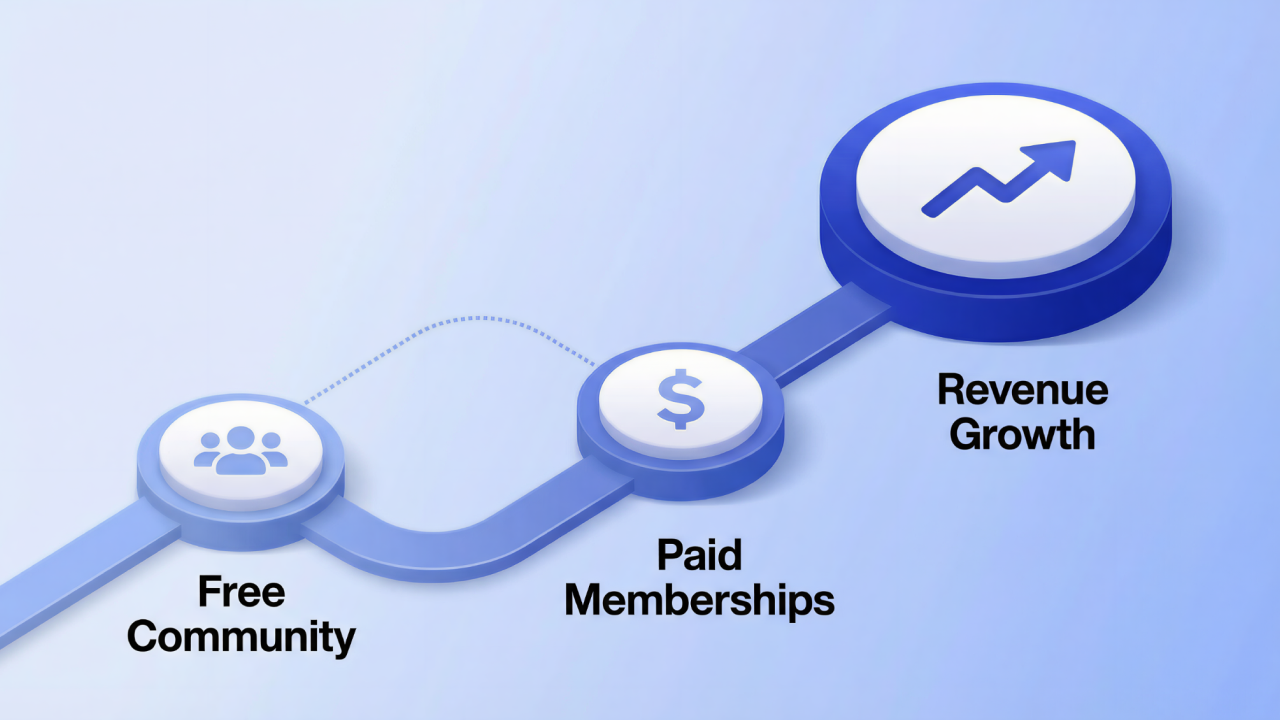
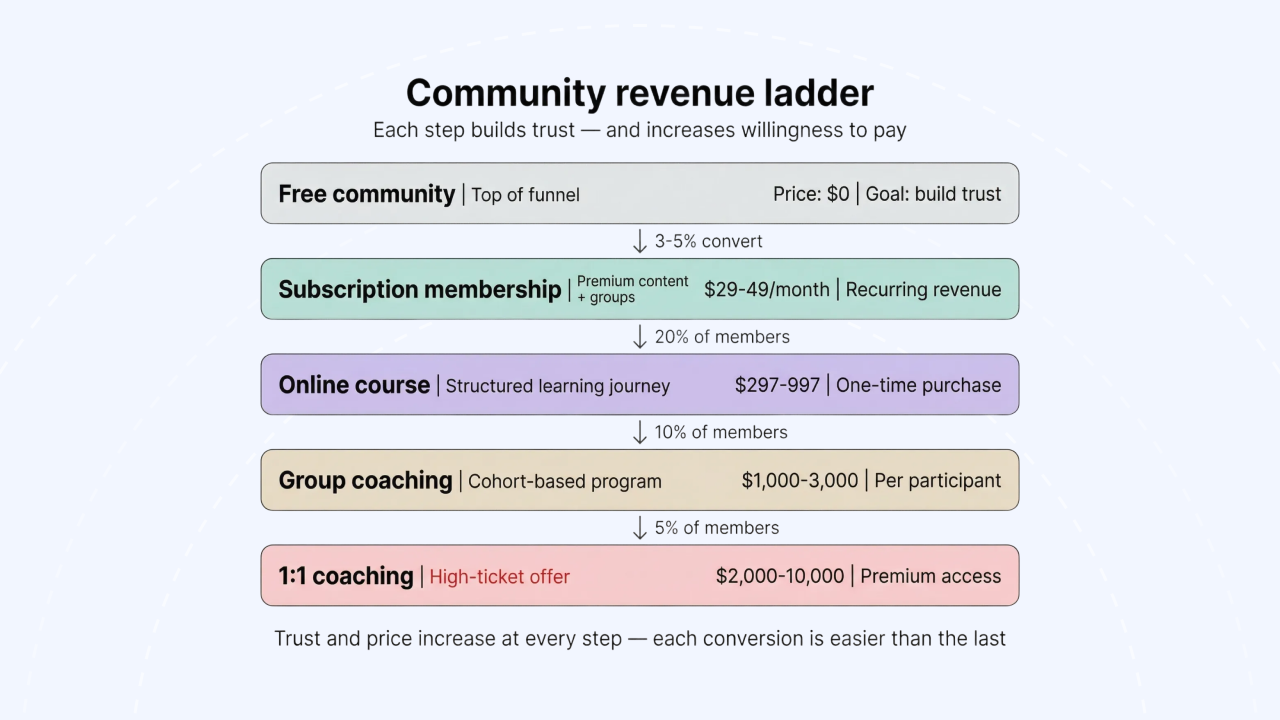
Most community builders pick one revenue stream and wonder why growth feels slow. The ones generating serious income don't choose between subscriptions, courses, and coaching, they stack them in a deliberate sequence where each step builds on the trust created by the last.
To make it more clear, the free members sit at the top, which is the widest, most accessible entry point.
As trust builds, a percentage moves down into paid tiers, each one smaller in audience but significantly higher in price. The math works because you don't need everyone to reach the bottom, you just need the right people to keep moving down.
How Much Can You Actually Make? The Real Numbers
I'm not going to promise you six figures from 50 members. But I will show you the actual math, conservative conversion rates, realistic pricing, no best-case assumptions.
Here's what a full stack community looks like at different audience sizes:
| Community size | Subscription ($39/mo) | Course (20% buy at $297) | Coaching (5% buy at $1,500) | Realistic annual revenue |
| 50 active members | $23,400/yr | $3,564 | $3,564 | ~$29,000/yr |
| 100 active members | $46,800/yr | $7,128 | $7,128 | ~$58,000/yr |
| 200 active members | $93,600/yr | $14,256 | $14,256 | ~$117,000/yr |
| 500 active members | $234,000/yr | $35,640 | $35,640 | ~$292,000/yr |
A few things to keep in mind: these numbers assume all members are paying, in reality you'll need roughly 5x your target in free members to hit these figures at a 20% conversion rate. The $39/month is deliberately conservative; most niche communities charge $49–97/month. Course and coaching revenue compounds over time rather than landing in year one.
The pattern that holds at every size: you don't need a massive audience. You need a focused one. 200 deeply engaged members will always outperform 2,000 passive ones.
The Platform You Choose Determines How Much Revenue You Actually Keep
Most people think about monetization as a revenue problem. I think about it as a margin problem.
You can build a community doing $10,000/month and still take home less than someone doing $5,000/month, depending on what your platform is taking from every transaction.
Here's what I mean.
SaaS community platforms typically charge two things: a monthly subscription fee AND a percentage of every sale you make.
Kajabi starts at $143/month and Mighty Networks charges transaction fees on every single plan, from 3% on their entry plan down to 1% on their top tier.
At $10,000/month in community revenue on Mighty Networks' entry plan, that 3% costs you $300/month, roughly $3,600/year, just in platform cuts on top of your subscription.
The alternative is building on infrastructure you own. A self-hosted WordPress setup costs roughly $900/year total, platform plus quality hosting. Stripe's 2.9% + $0.30 per transaction is the only cut anyone takes, and that's payment processing you'd pay on any platform regardless.
My point here isn't that SaaS platforms are bad and WordPress is better. The point is that your monetization strategy and your platform choice aren't separate decisions; they're the same decision.
Which means, every percentage point in transaction fees is a percentage point that doesn't compound into your community's growth.
Where to Start: Your Monetization Action Plan
Last but not the least, most community builders overcomplicate monetizing their community. But it’s not! This here is far most relevant and honest sequence:
- Build the free community first. Get 50 people genuinely engaged before you think about charging anyone.
- Launch one paid tier. One free tier, one paid at $39–49/month. See who converts.
- Add a course when the same question keeps coming up. That question is your course.
- Layer in coaching once you have course graduates. They're your warmest prospect for everything that comes next.
The platform you build on matters less than the sequence you follow. If you want full ownership without transaction fees, WordPress with BuddyBoss is where I'd suggest you start.
Frequently Asked Questions
How many members do you need before monetizing?
There's no magic number, but 50 genuinely active members is a reasonable minimum. Below that you don't have enough social proof to make paid membership feel valuable. Focus on engagement quality first, 50 members who show up consistently is worth more than 500 passive ones.
How much can you realistically make from a community?
At 100 paying members with a full stack including subscription, course, and coaching, you're looking at roughly $58,000/year at conservative conversion rates and pricing. At 200 members that becomes $117,000/year. The numbers depend more on engagement and focus than on raw audience size.
What's the difference between a free and paid community?
A free community builds trust and habit. A paid community delivers deeper value — exclusive content, private access, direct coaching, advanced resources. The most effective model runs both: free members participate openly, paid members unlock a noticeably richer experience.
Which platform should I use to monetize a community?
The most important factor is whether the platform charges transaction fees on your revenue. SaaS platforms like Mighty Networks charge 1–3% on every sale regardless of plan. A self-hosted WordPress setup costs roughly $900/year with no transaction fees beyond standard payment processing. For full ownership and maximum margin, WordPress is the stronger long-term choice.
How do I create a membership site on WordPress?
Install WordPress on quality hosting, add BuddyBoss Platform (free) for community features, add MemberPress for membership levels and billing, configure Stripe for payment processing, and create your content tiers. The full setup takes 2–4 hours, if you are determined and already understand WordPress. BuddyBoss combined with MemberPress is one of the most widely used WordPress membership stacks, with thousands of active communities running on this combination.