
BUDDYBOSS SERVICES
All-In-One Bundle
Save $1,697
Web Scale
+ DFY Website
App Launch
+ Fully Managed App
BROWSE BY CATEGORY
FEATURED INTEGRATIONS






eCommerce

Page Builder

Events

Automation

Forms

Tony Polecastro
Founder, Tony’s Acoustic Challenge
PRODUCT
SUPPORT

Best Skool Alternative
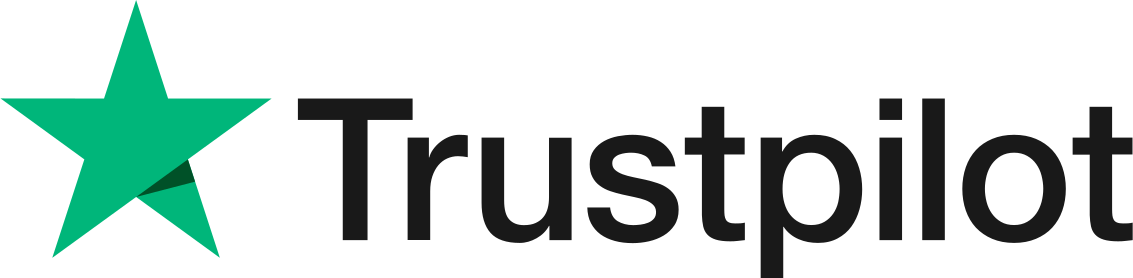

Skool costs $1,188/year. Save 75% with BuddyBoss
Skool locks your community, your members, and your revenue into their servers and charges a 2.9% transaction fee on Pro. BuddyBoss puts everything on your own infrastructure: your data, your brand, your business, for just $299 in year one.
Trusted by 50,000+ communities worldwide
Why pay more when you can own better?

Skool
3.7
/5
For creators who want the fastest possible launch with zero technical setup, Skool gets you live in an afternoon, but its single feed, shallow gamification, and Skool-branded app limit you fast, and it will cost over $3,900 more over 5 years.
Single activity feed with no sub-groups or spaces
Transaction fees on every sale: 10% Hobby, 2.9% Pro
Skool-branded app: no white-label option at any price

BuddyBoss
4.5
/5
For community builders who want full data ownership, best-in-class courses, gamification and fixed annual pricing, BuddyBoss is the definitive choice.
Only $299 in year one, no monthly fees
Keep 100% of every payment, zero fees
Full data ownership on your own server
Native LearnDash, WooCommerce, gamification
Skool vs BuddyBoss: Detailed Comparison
Skool exploded in popularity in 2024, and that explosion had almost nothing to do with the product. Alex Hormozi invested in the platform and launched the Skool Games, a publicity stunt designed to pull as many influencers as possible onto Skool in 30 days. It worked, and thousands of creators followed. In 2026, with the hype cooling and real communities doing real work, the questions are sharper: does Skool actually deliver, and what happens when you build your entire business on a platform you do not own?
Where Skool is a closed SaaS product running your community on Skool’s servers under Skool’s brand, BuddyBoss is a self-hosted WordPress platform that puts everything under your control. Your members, your content, your data, your brand identity, and your revenue all live on infrastructure you own.
We’ve spent years building and advising communities on both platforms. In this comparison, we’ll walk you through everything that matters: features, pricing, data ownership, mobile apps, and the real costs you won’t find on their pricing pages. By the end, you’ll know exactly which platform is right for your goals.
The verdict: BuddyBoss vs Skool scored.
We’ve scored both platforms across 8 key dimensions, each rated out of 5 stars, to give you a clear, objective comparison.
Dimension

BuddyBoss
Skool
Overall Score
4.5
3.7
Expected Features
5.0
3.5
Unique Features
5.0
2.5
Helps You Succeed
4.5
3.5
Pricing & Fees
4.5
2.5
Pros & Cons
4.5
3
Ease of Use
4.0
4.5
User Reviews
4.5
3.8
Customer Support
4.0
3.5
Who’s building on BuddyBoss?
-

Serial entrepreneur Jordi Ber built a B Corp culinary platform with Worldchefs accreditation and 50+ Michelin-starred chefs.
Scoolinary
Founder & CEO, Scoolinary
Members
400K+ users
25K
295K
214K

-

Carrie Green connected 1 million+ followers. Gained 1,200 new members in one week versus 1,000 in the entire first year.
Female Entrepreneur Association
Founder, Female Entrepreneur Association
Members
5,000+ members
63K
92K
650K+

-

Irish twins David and Stephen Flynn built a plant-based lifestyle platform with 600+ recipes, 15+ courses, 100K+ participants, and a 4.7-rated app.
The Happy Pear
Co-founder, The Happy Pear
Members
12,000+ members
544K
1M
679K

-

Guitar teacher Tony Polecastro grew from 60 students to 41,800+ with a daily challenge format.
Tony’s Acoustic Challenge
Founder, Tony’s Acoustic Challenge
Members
41,800+ students
593K
30K
46K

Feature Comparison: BuddyBoss vs Skool
Here is a detailed, feature-by-feature breakdown of what each platform offers, followed by a look at where each platform has a clear edge.
Similar Features: Detailed Breakdown
Groups & activity feeds
BuddyBoss
BuddyBoss gives you unlimited groups and feeds on all plans. Every group can have any combination of features enabled, activity feeds, forums, messaging, events, with no restrictions on how you configure them. Groups are tied to member profiles and the gamification system, creating a genuinely interconnected social experience.
Skool
Skool provides a single activity feed for all content within a group, which keeps things simple for small communities but creates a wall of noise as membership grows. There are no sub-communities, no multiple spaces, and no way to separate conversations by topic beyond hashtag search. For a focused single-topic group the simplicity is genuinely useful, but for operators who need structure, the single feed is a hard ceiling that cannot be worked around.
Members & profiles
BuddyBoss
Unlimited members on all plans, with fully customisable member profiles: profile fields, social links, activity history, course progress, group memberships, and gamification badges all in one place. Member profiles are a genuine social identity within the community, not just an account page.
Skool
Skool member profiles show basic information alongside a points tally and leaderboard rank, which suits the platform’s gamification focus. Profile depth is limited: there are no custom fields, no cover images, and no social connection graph beyond the activity feed. Members see each other’s contribution scores prominently, which reinforces the points-as-status dynamic. For operators who want members to build genuine profiles and relationships, it falls short.
Messages & notifications
BuddyBoss
BuddyBoss has the most advanced messaging and notifications system of the two: site-wide messaging as well as group messaging, with granular admin controls over what members can and can’t do. Members manage their own notification preferences per group and per activity type, reducing fatigue without you having to manage it.
Skool
Skool’s chat is limited to a group chat and basic direct messages; there is no dedicated private-messaging inbox between members. Chat within the platform is otherwise limited to post comments. There is no configurable notification preferences beyond basic in-platform alerts, and no push notification infrastructure tied to a branded app. Members who want a structured private conversation thread are pushed off-platform, which fragments community relationships.
Gamification
BuddyBoss
BuddyBoss ships with built-in gamification covering points, awards, achievements, ranks, and competitions, designed around community psychology research to reward the behaviours that build genuine long-term engagement. It also deeply integrates with GamiPress, the most comprehensive gamification platform on the web, adding hundreds of trigger actions, custom point types, and reward mechanics you can configure to match exactly how your community works. No other platform comes close to this depth.
Skool
Skool’s gamification awards points based on likes received on posts and comments, with nine levels from Newbie to Grandmaster shown on a leaderboard. It is not based on a sound understanding of game mechanics: it rewards members for posting frequently and soliciting reactions, which incentivises spammy behaviour and discourages long-time contributors who focus on depth over volume. Admins cannot award points manually, there are no badges, and there is no way to tie progression to anything outside the feed.
Monetisation
BuddyBoss
BuddyBoss integrates with hundreds of world-class payment providers, ecommerce platforms, and membership systems: WooCommerce, MemberPress, Restrict Content Pro (which is free), and many more. No transaction fees on any plan. You choose your payment processor, you own the billing relationship, and you keep 100% of what you earn.
Skool
Skool supports paid memberships and course sales through Stripe Express, and the 2026 update adding freemium and tiered pricing within a single group gives operators more flexibility at launch. The transaction fee structure is the significant drawback: the Hobby plan takes 10% of every sale, and the Pro plan charges 2.9% on top of Stripe’s own processing fees. Running multiple groups multiplies the monthly cost as each community requires its own Pro subscription.
Events & meetings
BuddyBoss
BuddyBoss integrates directly with Zoom, giving every social group its own meeting calendar. Members can attend meetings right from inside the browser, and recordings are automatically organised within the group, with access permissions respected for locked or private groups. For more advanced event management, BuddyBoss also integrates with The Events Calendar and other dedicated tools.
Skool
Skool includes a built-in events calendar with support for live calls and webinars, which covers the basic use case for operators who run regular group calls. There is no advanced event management, no ticketing, and no RSVP flow beyond calendar listings. For a weekly coaching call or monthly webinar, Skool’s events feature is sufficient. For operators building more involved event programmes with tiered access and in-person components, the tooling is limited.
Courses & content
BuddyBoss
BuddyBoss offers a true learning management system through deep integration with three of the most popular course platforms in the world: LearnDash, MemberPress Courses, and Tutor LMS. This gives you world-class online course functionality, quizzes, student progress tracking, certifications, drip content, and even course marketplace functionality. All available from the entry plan.
Skool
Skool added native video uploads with auto-captions in 2026, which removes the need for external video hosting. The underlying course structure is still a basic classroom: a collection of video modules organised into sections, with level-locked content gating access behind gamification rank. There are no quizzes, no certificates, no assignment submissions, and no granular progress reporting. For structured learning programmes with accountability and assessment, it is minimal functionality.
Moderation & member management
BuddyBoss
The moderation features in BuddyBoss are the most robust by a significant margin, and all available on all plans with no restriction on the number of moderators you can have. Members can report posts, comments, and other members. Admins can set up custom reporting categories, automatic suspension rules, and moderation workflows. It’s the only platform on this list that treats moderation as a first-class feature.
Skool
Skool has limited moderation: no keyword filtering, no role-based permissions beyond four preset roles, and a basic AutoMod AI flag; robust enterprise moderation is absent. There is no moderation queue and no granular permission configuration for moderators. For operators managing communities at scale, where bad actors, spam, and sensitive content require active management, Skool’s moderation capability is not fit for purpose.
Workflows & automations
BuddyBoss
BuddyBoss has a deep integration with Uncanny Automator and AutomatorWP, allowing you to automate thousands of different actions inside your community or across hundreds of external platforms, based on any trigger you can imagine. Welcome DM sequences, content dripping, Slack alerts, Instagram publishing, affiliate triggers, the sky is the limit, all without writing a line of code.
Skool
Skool has no automation or workflow builder. There are no drip sequences, no onboarding flows, no automated tagging, and no way to trigger actions based on member behaviour. It offers a limited Zapier integration (basic member-event triggers only; no post scheduling or content actions); there is no native Make integration and no open REST API. Every onboarding step, follow-up, and re-engagement action must be handled manually or through that limited Zapier path.
Mobile community app
BuddyBoss
BuddyBoss gives you your own fully native, white-label mobile app in the App Store, branded with your name, logo, and colours, from $219/month. This is not a shared platform app. It’s a fully customisable, drag-and-drop app builder where you can surface any content you want. Building and maintaining an app like this independently would cost hundreds of thousands of dollars a year.
Skool
Skool provides native iOS and Android apps which function reliably. The apps are Skool-branded: members download the Skool app, log in, and access their group, but the app itself carries Skool’s identity, not the community owner’s. There is no white-label mobile app option at any price point. For operators whose brand positioning is central to the member experience, this is a meaningful limitation.
Unique Features: Where Each Platform Shines
Unique Features of Skool
Native video hosting (2026)
Skool added native video uploads with auto-captions in 2026, removing the need for external Vimeo or YouTube hosting for course content. For creators building simple video-based courses, this reduces dependency on third-party tools.
Simple, fast setup
Skool is cloud-hosted with no server configuration required. A community can be live in hours with no technical setup whatsoever. For creators prioritising speed over control, this is Skool’s clearest practical advantage.
Hormozi/creator ecosystem
Skool’s association with Alex Hormozi and the Skool Games created a dense network of coaches and course creators on the platform. For operators who want discovery within Skool’s community marketplace, that ecosystem is a real advantage.
Unique Features of BuddyBoss
White-label mobile app
BuddyBoss offers a fully white-label native iOS and Android app, published under your own developer accounts in the App Store and Google Play. Your members download your brand, not a shared Circle app used by every Circle community in the world. Available as an add-on to all plans from $219/month.
World-class LMS integrations
BuddyBoss integrates natively with several of the best-in-class learning management systems available: LearnDash, LifterLMS, MemberPress Courses, and Tutor LMS. Every one of these is a fully featured, fully functional LMS platform that completely eclipses Circle’s ability to deliver first-class education. Together they give you quizzes, graded assessments, certifications, drip content, course marketplaces, and deep student progress tracking, all running inside your community.
Gamification that works
BuddyBoss supports points, achievements, leaderboards, and campaigns, all fully customisable to your community. Circle offers only basic points and levels, which research shows can actively harm community engagement by rewarding volume over quality. BuddyBoss gamification is built to drive genuine participation.
Complete data ownership
Your community lives on your own server. You own the database, the member records, the content, everything. The open-source WordPress core means no vendor lock-in, and 10,000+ plugins give you access to the world’s most mature marketing and automation ecosystem.
Helping you achieve your community goals.
Every community has three fundamental goals: build a great experience, launch with impact, and grow sustainably. Here’s how each platform performs against each.
Goal 1: Build a world-class community experience
BuddyBoss
BuddyBoss is fully open source, so anything you want to change, you can. It ships with ReadyLaunch, giving you a polished, ready-to-go community interface in one click for free, and the BuddyBoss Theme lets you reshape every detail from there. Because it runs on WordPress, you also get access to thousands of best-in-class plugins for courses, eCommerce, memberships, and more. If you have a vision for a community that looks and feels unlike anything else, BuddyBoss is the only platform built to get you there.
Skool
Skool offers a consistent, clean interface, but the experience belongs to Skool, not to the community operator. Members download the Skool app, not your app. The single activity feed limits how you can organise a growing community, and the gamification system rewards frequent shallow posts over genuine value. Customisation is minimal: no colour control, no font control, no ability to remove Skool branding from any member-facing surface.
Goal 2: Launch with maximum impact
BuddyBoss
ReadyLaunch gets your BuddyBoss community live in one click, with a polished, optimised setup that matches Circle’s out-of-the-box experience. But BuddyBoss doesn’t stop there. Deep integrations with WooCommerce, MemberPress, and FunnelKit give you a complete launch and funnel system from day one, capable of running full marketing campaigns, sales funnels, and recurring launch cycles that rival ClickFunnels or Go High Level. You get the speed of a simple setup and the full power of a world-class launch platform in the same tool.
Skool
Skool’s launch experience is genuinely fast: sign up, create a group, and you can have a basic community and course live in a matter of hours, with no technical setup required. The constraint is the economics: the Hobby plan takes 10% of every sale, and Pro at $99/month is the minimum to avoid punishing transaction fees. A creator making $2,000 in their first month on Hobby is paying Skool $200 in platform fees before the $9 subscription.
Goal 3: Grow and sustain a thriving member environment
BuddyBoss
BuddyBoss gives you unlimited groups, members, feeds, messaging, and media storage at a fixed annual price that never moves no matter how much you grow. The gamification system is built on research into online community behaviour, designed to promote the kinds of natural, genuine participation that keeps communities alive for years. And because BuddyBoss runs on your own hosting, you control your infrastructure: when your community scales, you scale your hardware to match rather than paying a platform tax on your success. Your data stays yours, your costs stay predictable, and your platform grows with you.
Skool
Skool’s limited moderation, with no keyword filtering and no role-based permissions beyond four preset roles, is inadequate for communities that grow beyond a few hundred active members. The gamification system incentivises volume over quality, which becomes a more visible problem as membership scales and leaderboard competition intensifies. The per-group pricing model means operators who expand into multiple communities face multiplying monthly costs, with each new group requiring its own Pro subscription.
Pricing: what does each platform really cost?
Platform pricing is never as simple as the number on the pricing page. Here’s an honest breakdown of every cost, platform fees, transaction fees, hidden costs, and true total cost of ownership, so you can make a fully informed decision.
Skool
Pricing
Platform pricing is never as simple as the number on the pricing page. Here’s an honest breakdown of every cost, platform fees, transaction fees, hidden costs, and true total cost of ownership, so you can make a fully informed decision.
Free plan
There is no free plan. Skool offers a 14-day trial, after which you pay $9/month on Hobby or $99/month on Pro, or the community closes.
Transaction fees
Skool takes 10% of every sale on the Hobby plan, and 2.9% on the Pro plan, on top of Stripe’s own standard processing fees. A Pro community with 200 members paying $100/month loses around $6,960 a year in platform fees alone.
Additional costs to plan for
Skool’s pricing multiplies with scale. Each additional community you run requires its own separate Pro subscription. Three communities on Pro: $297/month, or $3,564/year. White-label mobile app: not available at any price. Members always download the Skool app.
- Each additional community: separate Pro subscription at $99/month ($1,188/year)
- Transaction fees: 10% on Hobby, 2.9% on Pro, on every sale
- White-label mobile app: not available at any price point
- Full LMS (quizzes, certificates, cohort management): not available
BuddyBoss Pricing
BuddyBoss Platform Pro starts at $299/year in year one ($399/year on renewal), with no per-member fees at any scale. Platform Plus is $349/year ($599/year renewal) and adds additional pro features. Unlike Circle, your platform cost is fixed whether you have 100 members or 100,000.
Free plan
Yes. BuddyBoss Platform is free to download and includes ReadyLaunch – a complete, fully functional community setup at zero cost, with no member caps, no space limits, and no time restrictions. Paid plans unlock the BuddyBoss Theme, gamification, the white-label mobile app, and advanced pro features.
Transaction fees
Zero. BuddyBoss takes nothing from your membership revenue on any plan. Standard payment processor fees apply (Stripe: 2.9% + 30¢), but every penny beyond that is yours.
Additional costs to plan for
Because BuddyBoss runs on WordPress, you will need a few things outside the platform licence:
The platform licence and add-on costs are fixed at any scale. Hosting scales with the performance you choose to provide your members – and that choice is always yours.
Pricing comparison: Skool vs BuddyBoss
Dimension
Skool
BuddyBoss
Free plan
No (14-day trial only)
Yes (free via Ready Launch)
Entry-level paid plan
$9/mo Hobby ($108/yr, 10% fee)
$299/yr (Platform Pro, year 1)
Core plan price
$99/mo Pro ($1,188/yr)
$399/yr (renewal)
Transaction fees
10% Hobby / 2.9% Pro
None
Additional costs
Per-community subscription multiplies; no branded app
~$674/yr (hosting + plugins + domain)
1 year TCO
~$1,188
~$674
5 year TCO
~$5,940
~$3,370
5-year saving with BuddyBoss
~$2,570
~$7,850
Pros and cons.
BuddyBoss
Pros
Complete customisation control: anything you can imagine, you can build
Unlimited groups and activity feeds
Unlimited members, admins, and moderators
Unlimited courses and memberships
Full data ownership: your community lives on your server
White-label iOS & Android app available on every plan
World-class gamification built in: points, awards, achievements, ranks, and competitions (Platform Plus and above)
Zero transaction fees: keep 100% of membership, eCommerce, and course sales revenue
Deep integrations with world-class eCommerce platforms: WooCommerce, Easy Digital Downloads, Restrict Content Pro, MemberPress
World-class LMS integrations: LearnDash, LifterLMS, MemberPress Courses, Tutor LMS
Compatible with best-in-class funnel building tools, including FunnelKit
Compatible with best-in-class automation and AI workflow tools, including Uncanny Automator and AutomatorWP
Built-in Zoom integration for one-to-one meetings and group coaching sessions
Open-source core built on WordPress: 60,000+ plugins, no lock-in
Cons
Requires WordPress hosting, straightforward to set up on virtually any managed host
Requires initial configuration and ongoing maintenance, minimal on most managed WordPress hosts
Skool
Pros
Genuinely simple to set up and use: no technical knowledge required
Clean, fast interface for members
Growing creator ecosystem with visibility from the Hormozi community
Native video uploads with auto-captions added in 2026
Flexible freemium and tiered pricing within a single group, introduced in 2026
14-day free trial available
Cons
Transaction fees on all plans: 10% on Hobby, 2.9% on Pro, regardless of your revenue
Per-community pricing multiplies cost fast: three communities on Pro cost $3,564/year
Gamification awards points for likes received, encouraging posting for attention over quality
Launched in 2019 with few substantive feature releases since
Reviews & ratings: what users are saying.
BuddyBoss consistently scores highest among WordPress community platforms. Skool grew rapidly in 2024 on the back of the Hormozi marketing wave; as longer-term operators share their experiences, a clearer and more critical picture of the platform’s limitations is emerging.
BuddyBoss
4.5/5
Average across 2 platforms
4.6
★
(
822
reviews
)
Capterra
4.3
★
(
18
reviews
)
Skool
1.7
/5
Trustpilot (not listed on G2 or Capterra)
1.7
★
(
46
reviews
)

★
(
reviews
)
Capterra
★
(
reviews
)
Skool reviews: 85% score 1 or 2 stars on Trustpilot
Skool holds a 1.7 out of 5 on Trustpilot across 46 reviews, with 85% rated 1 or 2 stars and 78% rated 1 star. The platform is not listed on G2 or Capterra. The small number of positive reviews (13%) praise simplicity: Skool is fast to launch, easy to navigate, and requires no technical setup. The complaint themes dominate: over half of all negative reviews describe scam communities operating freely on the platform, with reviewers reporting misleading offers and no accountability from Skool when they are defrauded. A third report that cancelling a subscription is either extremely difficult or deliberately hidden. 30% say refund requests go unanswered.
I am a software engineer with over four years of experience. I discovered a Skool community called Pivot2Tech, paid a $1,000 CAD enrollment fee after being promised client-sharing and refunds if unsuccessful. After payment, communication was minimal. When I asked about the promised client-sharing system, I was told I would have to find clients myself, directly contradicting what was explained during enrollment. When I requested the promised refund, the response was: ‘We don’t do refunds. Have some shame.’ I was then removed from the community groups.
Mahedee Zaman, CA · Trustpilot, March 2026
I never intentionally signed up for Skool in the first place. I ordered Hormozi’s books and, without my explicit permission, that somehow resulted in an automatic Skool subscription tied to my payment method. I was then billed for a service I never chose or wanted. When I tried to fix it, the cancel process was a mess. The option to cancel was buried, the interface kept trying to get me to enter card details just to cancel.
KEVIN, US · Trustpilot, April 2026
I used to really love Skool; it felt like a place where people could learn, share, and grow together. But now, it honestly feels like it’s becoming a shortcut for scammers to make quick money off unsuspecting members. Customer support has been a huge disappointment. The moment you speak up or ask for a refund, you get kicked out of the group and completely ignored.
Jayson Darang, KR · Trustpilot, October 2025
BuddyBoss reviews: 94% score 4 or 5 stars on Trustpilot
BuddyBoss reviews on Trustpilot read as the inverse of Skool’s. Across the BuddyBoss Trustpilot reviews: 87% are rated 4 or 5 stars, 82% are 5-star outright, and 12% are 1 or 2 stars. Three patterns recur across the praise: a support team that responds within hours rather than weeks; named engineers who follow problems through to resolution; and platform depth that competitors cannot match for LMS and community work.
“I recently had some issues with my website that I initially thought were caused by the BuddyBoss software. After Rezwan dug into it thoroughly with me, it turned out the problem wasn’t on the BuddyBoss side at all but came down to a configuration setting at my webhost. He takes the time to write detailed explanations and even records screen videos to walk you through things step by step. A great experience overall, and reassuring to know that BuddyBoss has solid support in place for when you actually need it.”
Pjotr, NL · Trustpilot, May 2026
“We have been running their software and everything has been fine. Recently we added app functionality which has been great so far. As we looked to get a better understanding of the layout conflicts and begin testing our app, we reached out for support. Prabs not only helped us, but his knowledge, attitude, and impact were well beyond expectations. Been in tech for thirty years, not sure I have ever come across someone as immediately familiar and knowledgable about the specifics we were working on.”
Gus Titzenheimer, US · Trustpilot, May 2026
“The support team was professional. I am really grateful to Rezwan who helped me multiple times. BuddyBoss is ahead of their competitors. There really is no better platform hands down. With each update BuddyBoss is becoming better and far more advanced and polished. Many thanks for a great product and excellent support.”
Samir, SE · Trustpilot, May 2026
Why you should switch from Skool to BuddyBoss.
These are the four reasons community operators who built on Skool during the 2024 hype wave eventually move to BuddyBoss. None of them are visible on day one. Each becomes painfully obvious only after months of investment, when the platform’s limits start to matter.
01
The Success Tax
Every Skool community runs inside the Skool app, regardless of which plan you pay for. Your members open an app called “Skool”, not your brand. BuddyBoss makes a white-label native iOS and Android app available on every paid plan: your name, your logo, your colours in the App Store. For any community builder who cares about brand recognition and member experience, that distinction matters.
02
The One-Way Door
When your community lives on Skool, your member data, your content, and your community history sit on Skool’s servers. There is no data export API, and if you ever leave the platform, you leave without your community’s history. BuddyBoss is self-hosted on your own server: your database, your content, your members, all owned entirely by you and exportable at any time.
03
Their Way or No Way
Skool charges 10% of every payment on the Hobby plan, and 2.9% on Pro, on top of Stripe’s own standard processing fees. On a $100/month membership community with 200 paying members, that 2.9% Pro fee costs you $6,960 a year in platform cuts alone. BuddyBoss takes zero. Every payment you collect stays with you, on every plan.
04
Help Is Not Coming
Skool’s course functionality is a collection of content modules locked behind gamification levels, sitting inside the same activity feed as your community posts. It is not a learning management system. BuddyBoss, with native LearnDash integration, delivers a full LMS running alongside your community: structured learning pathways, drip scheduling, quizzes, assignments, completion certificates, and cohort management.
Verdict: BuddyBoss vs Skool, which should you choose?
BuddyBoss is the right choice for serious community builders, course creators, coaches, and membership organisations who want a platform they own outright. At roughly $1,995 over five years against Skool Pro’s $5,940 or more, the cost advantage compounds alongside the feature advantage.
Skool does have a real use case. If you are a solo coach or creator launching your first community and you want to go live in an afternoon with no technical setup whatsoever, Skool delivers on that promise. The trade-off arrives as you grow: per-community pricing, transaction fees on every sale, and a Skool-branded app you cannot replace.
The turning point arrives for almost every Skool community eventually. As soon as you want a branded app, zero transaction fees, native courses with quizzes and certificates, deeper moderation, or the ability to run multiple communities without multiplying your monthly bill, Skool’s limits become structural rather than cosmetic.
Skool is a starter tool; BuddyBoss is a long-term foundation.
Frequently asked questions.
Quick answers to the most commonly asked questions about BuddyBoss vs Skool.
Is BuddyBoss better than Skool?
For most community builders, yes. BuddyBoss delivers deeper features across community, courses, moderation, and mobile, while costing significantly less over a five-year period (roughly $1,995 versus $5,940 or more on Skool Pro). It also gives you full data ownership and zero transaction fees on every plan. Skool has a simplicity advantage for brand-new communities with no technical setup, but BuddyBoss is the stronger platform for anyone building at scale or for the long term.
Can I switch from Skool to BuddyBoss?
Yes. You can export your member list from Skool as a CSV and import it into BuddyBoss; your course content and community posts will need to be rebuilt, as Skool does not provide a structured data export of your content or community history. Most community operators who switch report that the transition is straightforward given that BuddyBoss’s setup documentation and support resources are thorough.
Does BuddyBoss have a free plan?
Yes. Ready Launch is BuddyBoss’s free plan, hosted on WordPress, which lets you build and launch a community without any upfront cost. Paid plans start from $299 for year one, with no monthly fees and no transaction fees at any tier.
What is BuddyBoss Platform pricing?
BuddyBoss Platform Pro starts from $299 for year one as an introductory price; renewal pricing from year two is approximately $399 per year. There are no monthly fees and no transaction fees on any plan. The free Ready Launch option is also available for those starting out without a budget.
Does Skool charge transaction fees?
Yes. Skool charges 10% of every payment collected on the Hobby plan ($9/month), and 2.9% on the Pro plan ($99/month). Both rates are charged on top of Stripe’s own standard processing fees. BuddyBoss charges no transaction fees on any plan.
Which platform is better for online communities?
BuddyBoss has significantly more depth: unlimited groups and sub-communities, advanced moderation tools, full customisation, a white-label native mobile app, and 10,000+ WordPress plugin integrations. Skool offers a single activity feed per group, basic moderation, no customisation beyond a cover image, and a Skool-branded app. If feature depth, data ownership, and long-term cost matter, BuddyBoss is the stronger community platform.
Which platform has a better mobile app?
BuddyBoss. Every paid BuddyBoss plan includes a white-label native iOS and Android app: your community’s name, logo, and branding in the App Store and Google Play. Skool offers a native app for iOS and Android, but it is branded as Skool at every price point. There is no white-label mobile app option available from Skool on any plan.
Is Skool good for online courses?
Skool has basic course functionality: multi-module content collections with native video hosting (added in 2026) and auto-captions, plus level-locked modules. It is not a full learning management system. There are no quizzes, no certificates, no assignment submissions, or drip scheduling. BuddyBoss, with native LearnDash integration, covers all of those capabilities.
Ready to Own Your Community?
Join 50,000+ community builders who chose BuddyBoss for full data ownership, a branded mobile app, built-in courses, and fixed annual pricing that scales with your ambition, not against it.