












Your learners are busy. They are juggling work, family, and a dozen open browser tabs. They want to learn, but they need content that fits into their day, not a 90-minute training module that demands they clear their schedule.
That is where microlearning comes in. Instead of overwhelming people with hours of content, microlearning delivers focused, bite-sized lessons that take anywhere from 2 to 10 minutes to complete. It is designed to teach one concept at a time, making it easier to absorb, remember, and actually apply.
And it works. Research shows that microlearning achieves an 80% completion rate compared to just 20% for traditional long-form courses.
Learners retain up to 50% more information, and organizations develop microlearning content up to 300% faster than conventional training.
But what does microlearning actually look like in practice?
In this guide, I’ll walk you through 10 real microlearning examples, explain why each format works, and show you how to start implementing them in your own courses, communities, or training programs.
What Is Microlearning?
Microlearning is an approach to education that delivers information in short, focused bursts. Each lesson targets a single learning objective and typically takes under 10 minutes to complete.
Unlike traditional courses that try to cover an entire subject in one sitting, microlearning breaks knowledge into small, self-contained modules that learners can consume on their own schedule.
The concept is rooted in cognitive science. Hermann Ebbinghaus’ forgetting curve research found that people lose up to 50% of newly learned information within an hour and up to 90% within a month, unless they revisit it.
Microlearning addresses this directly by delivering content in digestible pieces and encouraging spaced repetition over time.
You are probably already using microlearning without realizing it.
Watching a 3-minute YouTube tutorial on how to fix a formula in Google Sheets, reading a quick how-to article, or completing a 5-question quiz on a topic you are studying are all forms of microlearning.
The difference is that when microlearning is intentionally designed as part of a course or training program, it becomes a powerful strategy for improving knowledge retention, boosting engagement, and helping learners build skills over time without feeling overwhelmed.
Why Microlearning Works: The Numbers
Before I tell you about specific microlearning examples, it helps to understand why this approach is so effective. Here are some key data points:
80% completion rate for microlearning modules, compared to roughly 20% for traditional long-form courses.
50% improvement in retention compared to conventional training methods.
300% faster to develop than traditional eLearning courses, reducing production time and cost.
50% increase in engagement when compared to traditional training formats.
93% of organizations now consider microlearning essential for effective corporate training.
The takeaway is straightforward: shorter, focused content leads to better learning outcomes. Now, let us look at how this plays out in practice.
10 Microlearning Examples Worth Trying
1. Short-Form Video Lessons (3–5 Minutes)
This is the most common and arguably most effective microlearning format. A single video lesson covers one specific concept, one skill, or one step in a larger process. Think of Duolingo’s language lessons or LinkedIn Learning’s quick skill videos.
How to use it: Break your course into modules where each video teaches one thing.
Instead of a 45-minute lecture on “Social Media Marketing,” create five separate 5-minute videos: one on choosing platforms, one on content calendars, one on hashtag strategy, and so on.
Your learners can watch one during a coffee break and come back for the next one later.
2. Interactive Quizzes and Knowledge Checks
Quick quizzes after a lesson reinforce what was just learned and activate recall, which is critical for long-term retention. These are not final exams; they are low-pressure checkpoints that help learners gauge their understanding.
How to use it: Add a 3–5 question quiz at the end of each lesson in your LMS. Include instant feedback so learners know why an answer was right or wrong. Most WordPress LMS plugins like LearnDash support this natively.
3. Infographics and Visual Summaries
A well-designed infographic can communicate a complex concept in seconds. Visual summaries work especially well for processes, frameworks, comparison charts, and step-by-step instructions that learners can save and reference later.
How to use it: Create a downloadable infographic for each major section of your course. For example, a fitness coach could provide a visual meal-prep guide; a business coach could share a one-page sales funnel framework. These double as shareable content for social media, too.
4. Daily or Weekly Drip Lessons
Instead of giving learners access to an entire course at once, drip content releases one lesson per day or per week. This creates a habit loop and prevents the overwhelm that leads to course abandonment.
How to use it: Set up a 30-day email sequence or a drip schedule in your LMS where each day delivers one micro-lesson. A writing coach might send a daily 5-minute exercise. A coding instructor might assign one small challenge per day. The key is consistency and building momentum.
5. Flashcards and Spaced Repetition
Flashcards are a classic microlearning format, and for good reason. When combined with spaced repetition, which involves revisiting information at increasing intervals, they are one of the most effective ways to move knowledge from short-term to long-term memory.
How to use it: Offer digital flashcard sets as supplementary material within your course. This works particularly well for vocabulary-heavy subjects (language learning, medical terminology, legal concepts). Apps like Anki use spaced repetition algorithms, but you can also build simple flashcard-style review modules directly in your LMS.
6. Scenario-Based Simulations
Short, interactive scenarios present a real-world situation and ask the learner to make a decision. They receive instant feedback on the outcome. This is one of the most powerful microlearning examples for building practical, applied skills.
How to use it: Create “What would you do?” scenarios relevant to your audience. A customer service training course might present a difficult client interaction with multiple response options. A leadership program might simulate a team conflict. Keep each scenario under 5 minutes with clear, actionable takeaways.
7. Community Discussion Prompts
A thought-provoking question posted in a community forum or group is a form of microlearning that many creators overlook. When learners articulate their understanding in their own words and learn from peer responses, retention deepens significantly.
How to use it: After each module, post a discussion prompt in your community space. For example: “What is one thing you learned this week that you have already applied?” or “Share your biggest takeaway from today’s lesson.”
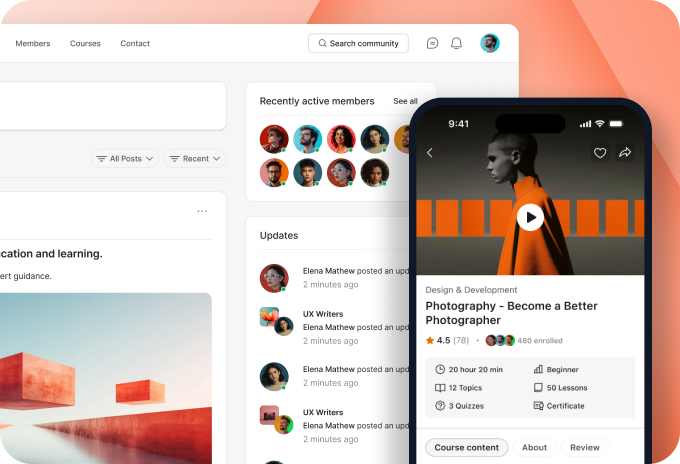
Platforms like BuddyBoss make this easy with built-in activity feeds, social groups, and discussion forums that live alongside your course content.
8. Gamified Challenges and Leaderboards
Adding game mechanics like points, badges, streaks, and leaderboards turns passive learning into an active, competitive experience. Companies that incorporate gamification into their microlearning see up to a 60% increase in engagement.
How to use it: Award points for completing daily lessons, participating in discussions, or scoring well on quizzes. Display a leaderboard in your community to create friendly competition. BuddyBoss supports gamification natively with points, badges, and leaderboard features built into the platform.
9. Checklists and Job Aids
Sometimes the best microlearning is not a lesson at all; it is a quick-reference tool. Checklists, cheat sheets, and step-by-step job aids give learners something they can pull up in the moment they need it, right at the point of application.
How to use it: Create downloadable PDFs or pinned posts in your community for key processes. A project management course might include a “Launch Day Checklist.” A photography course might offer a “Camera Settings Cheat Sheet.” These resources reinforce learning and give members a reason to keep coming back to your platform.
10. Push Notification Micro-Nudges
Short, actionable reminders delivered via mobile push notifications keep learning top-of-mind without requiring the learner to actively seek it out. These nudges work best when they reinforce a concept already taught or prompt a small daily action.
How to use it: If you have a branded mobile app (like the BuddyBoss Course App), use push notifications to deliver daily tips, motivational prompts, or reminders to complete a lesson.
A wellness coach might send “Today’s 2-minute mindfulness exercise is ready.” A sales trainer might push “Quick tip: Try the 3-second pause technique in your next call.” These micro-nudges create a habit loop that drives consistent engagement.
How to Start Creating Microlearning Content
You do not need to rebuild your entire course library. The best way to start with microlearning is to work with what you already have and break it into smaller, more focused pieces. Here is a practical framework:
Audit Your Existing Content
Look at your current courses or training materials. Where are learners dropping off? Which lessons are too long? Identify the sections that can be split into standalone micro-modules without losing context.
One Lesson, One Objective
Every microlearning module should answer one question or teach one skill. If you find yourself covering two or three ideas in a single lesson, split them up. This is the golden rule that separates effective microlearning from content that has simply been chopped into smaller pieces.
Mix Your Formats
Do not rely on one content type. Combine short videos with quizzes, infographics, discussion prompts, and downloadable resources. Variety keeps learners engaged and accommodates different learning styles.
Add Community Touchpoints
Microlearning works best when it is social. Pair your micro-lessons with community interactions: discussion prompts, peer feedback, group challenges, or weekly live Q&A sessions. This is where platforms that combine courses and community, like BuddyBoss on WordPress, have a major advantage over standalone LMS tools.
Measure and Iterate
Track which micro-modules get the highest completion rates, the best quiz scores, and the most community engagement. Use that data to double down on what works and improve what does not. Your LMS analytics and community insights should guide your content strategy over time.
Build Your Microlearning Experience on a Platform You Own
The most effective microlearning examples share something in common: they combine focused content with community interaction, mobile accessibility, and a platform that supports ongoing engagement, not just one-time course consumption.
If you are looking for a solution that brings together a powerful LMS, built-in community features, gamification, and a branded mobile app, BuddyBoss gives you everything you need to create a microlearning-powered learning experience on WordPress, fully under your control.
Ready to create bite-sized learning that sticks? Explore BuddyBoss and start building your microlearning platform today.
