













Solo fitness apps have an attrition problem. People buy them, use them for three weeks, and quietly stop opening them. The app did not fail. The isolation did.
Fitness is inherently social. People push harder when someone is watching. They show up more consistently when someone notices if they do not. They keep paying for a membership when the community is the thing they are paying for, not just the content.
This is why fitness coaches who build community around their programs see retention numbers that standalone apps cannot touch. If you are a fitness coach, personal trainer, or gym owner who wants to serve clients beyond 1:1 sessions, the question is not whether to build a community. The question is which platform can handle the specific workflow fitness communities require.
Why Online Fitness Communities Have Higher Retention
The research on this is consistent across very different populations: perceived social support and accountability predict better exercise adherence. Studies on college students, older adults, and people in structured rehab programs all find the same pattern, whether the “someone watching” is a friend, a coach, or a peer group.
That is not a feature. That is the product. The workouts, the nutrition guides, the video libraries: those are table stakes. The reason members stay past month three is the group chat where someone asks if you finished your workout. The leaderboard that shows your name moving up. The forum post where someone shares a progress photo and gets 30 comments of genuine encouragement.
A solo fitness app can deliver content. Only a community can deliver that.
What a Fitness Community Actually Needs
Not every feature matters equally. Before you evaluate platforms, get clear on what your community specifically requires.
The Must-Haves
Group challenges with clear start and end dates. Challenges are the highest-activation feature in fitness communities. A 30-day challenge with a visible leaderboard and daily check-in threads drives more engagement than any content library. Your platform needs to support this without custom development.
Video delivery that does not throttle or restrict. Your workouts live on video. That video needs to be embeddable, searchable, and organized into programs or categories. Most fitness coaches host video on YouTube (unlisted), Vimeo, or a dedicated video host and embed it in their community platform.
Direct messaging and group messaging. Members want to message their coach. They want to message each other. A platform without private messaging forces conversations into public threads, which kills the intimate accountability dynamic that makes fitness communities work.
Activity feeds and progress visibility. Members need to see each other’s wins. An activity feed where members can post check-ins, progress photos, and workout completions creates the social proof loop that keeps everyone motivated.
Paywall and tiered access. You need to separate free from paid, and potentially differentiate between membership tiers (basic vs. premium, monthly vs. annual program cohort).
The Nice-to-Haves
Workout tracking built directly into the platform. Most fitness community platforms do not have this natively, and the workaround (members logging in a separate app and posting screenshots) actually works fine for accountability purposes.
Nutrition tracking integration. Again, most coaches solve this by recommending a separate app and using the community for accountability conversations around nutrition, not the tracking itself.
Live streaming. Useful but not essential. A recorded library plus synchronous group calls covers most use cases.
Platform Comparison: Fitness-Specific Tools vs Community Platforms
Trainerize
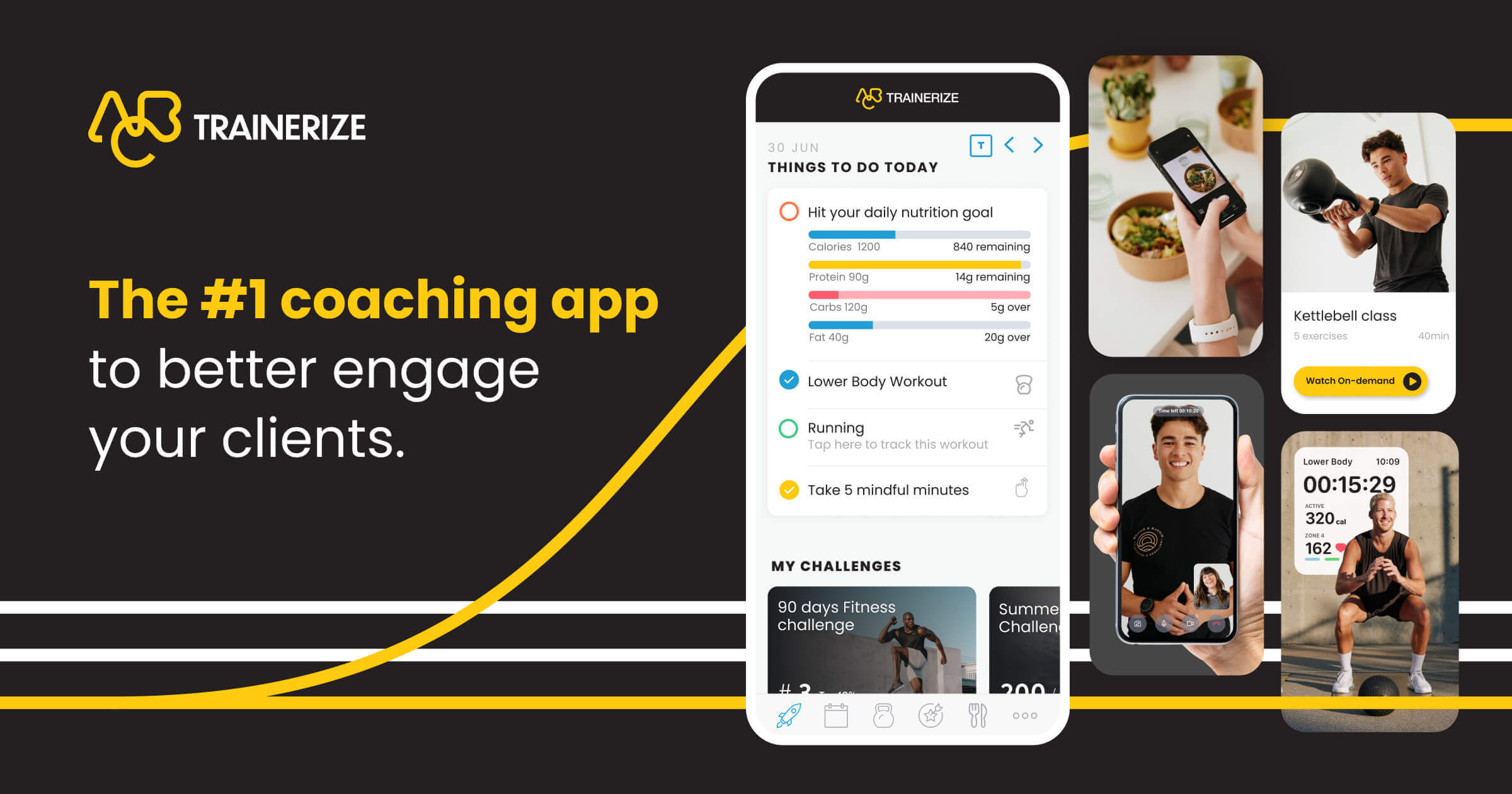
Trainerize (now ABC Trainerize, following its acquisition by ABC Fitness) is purpose-built for fitness coaching. It handles workout plan delivery, exercise video libraries, habit tracking, nutrition logging, and client check-ins. It does have a basic community feature, a private social feed where clients post and interact, but multiple independent reviews describe it as covering the basics only. Coaches specifically looking for public, socially visible group challenges and leaderboards are usually pointed toward alternatives like TrueCoach or Everfit instead.
Pricing runs from a free single-client plan, through Pro tiers that scale with roster size (roughly $23-25/month for 5 clients up to $225-250/month for 200 clients), up to a Studio Plus tier priced per location. Nutrition coaching, payment processing, and a branded client app are separate paid add-ons on most plans, which is why real-world monthly costs tend to run well above the headline price once a coach adds what they actually need.
Trainerize is the right tool for a PT with 20 to 50 individual clients who need structured program delivery. It is not the right tool for building a community of 200 members who support and motivate each other.
Mindbody
Mindbody is primarily a business management platform for gyms and studios: scheduling, booking, payments, staff management. It serves physical locations well.
For a fully online fitness community, Mindbody has significant gaps. The community features are minimal, and the platform doesn’t publish standard pricing; you typically need to talk to a sales team to get a quote, though independent estimates for 2026 put the entry tier around $99-159/month per location, rising to $499-699+/month at the top tier, plus payment processing fees. The pricing model is designed for studios doing volume class bookings, not for solo coaches building online membership communities.
Mindbody is the wrong tool for this job unless you are running a hybrid gym-and-online business and already have it for the in-person side.
Mighty Networks
Mighty Networks is a SaaS community platform with a fitness-friendly feature set. It supports courses, live events, group challenges, member profiles, and an activity feed. The mobile app is polished and easy for members to use.
The limitations: transaction fees on member payments that never fully disappear (2% on the entry tier down to 0.5% on higher tiers, confirmed against current 2026 pricing), limited customization on branding and layout, and content lives on Mighty’s servers. For fitness coaches specifically, there is no native workout tracking, and video delivery depends on Vimeo embed or native upload with storage that scales by tier, from a few hundred GB on entry plans up to several TB on higher ones. Check Mighty Networks’ current plan details directly before quoting a specific number to a reader, since tier names and exact storage allocations have shifted more than once in 2026.
Mighty Networks is a reasonable starting point for a fitness coach launching a first community. The trade-off is that you are building on rented land, and the transaction fee never reaches zero on any tier.
Circle
Circle is community-first and well-designed. Spaces, member profiles, events, courses, and a clean member experience all come standard, along with built-in email marketing through Circle’s Email Hub.
The challenge for fitness coaches specifically: Circle is built for discussion-based communities. It handles forums, posts, and DMs well. It is less suited to the activity-feed-plus-challenge structure that drives fitness community engagement. There is no native challenge or leaderboard feature as of this writing. Like Mighty Networks, you pay transaction fees at lower tiers and your data lives on their infrastructure.
BuddyBoss
BuddyBoss runs on WordPress and gives you a full social community layer: member profiles, private messaging, activity feeds, groups, forums, and a mobile app for iOS and Android.
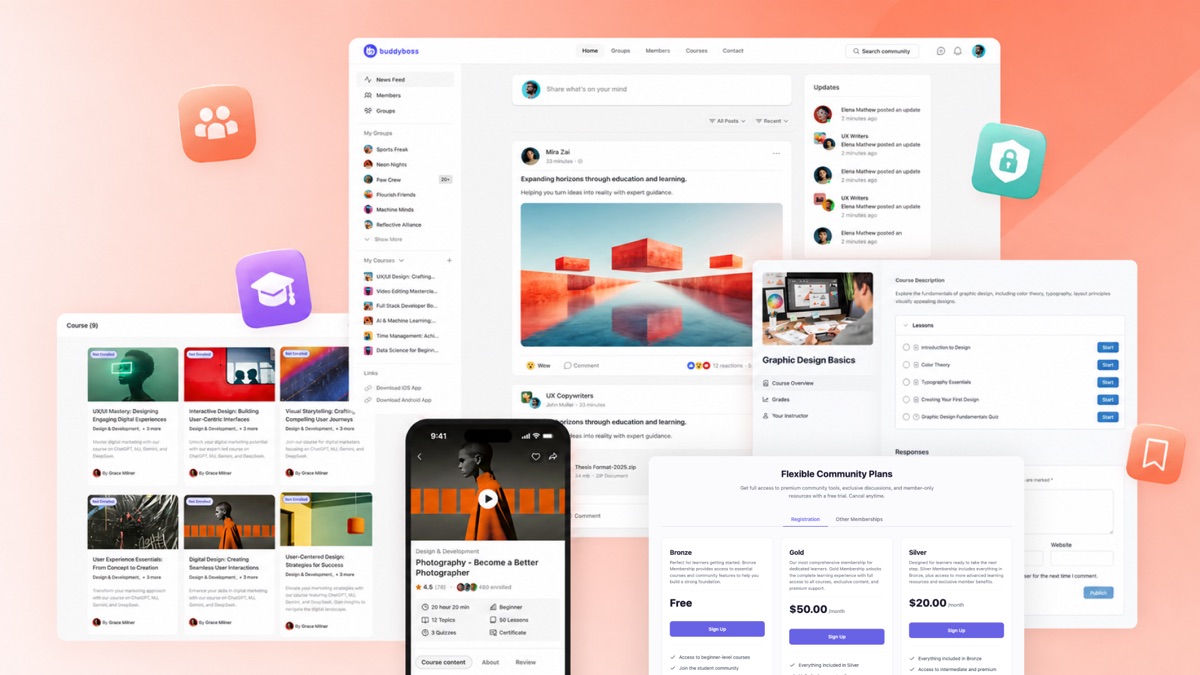
For fitness communities specifically, the structure works like this:
Groups for challenges. Create a BuddyBoss Group for each challenge with a start date, end dates, and pinned instructions. Members post check-ins to the group activity feed. The coach pins leaderboard updates. The social visibility is built into the group structure.
Program delivery, two ways. BuddyBoss now includes Memberships and Courses natively, free on the Launch and Scale plans. For a straightforward 12-week program with sequential lessons and progress tracking, this covers it with nothing extra to install. If you specifically need completion certificates, LearnDash (the most widely used WordPress LMS) integrates directly with BuddyBoss and adds that on top of the same sequential structure. Either way, members work through the program with each week unlocking in order, and their progress shows on their profile.
Activity feeds for accountability. The BuddyBoss activity feed is member-driven. Members post workout completions, tag coaches, share progress photos. Other members comment and react. This is the social proof loop that drives retention.
Badges and points, built in. Gamification, points, badges, and leaderboards, is native to BuddyBoss on the Scale plan. No separate plugin required. Award points for consecutive check-ins, badges for completing a challenge, and surface leaderboards by points, all configurable without custom code.
Paywall, native or via a plugin. If you’re starting fresh, BuddyBoss Memberships and Courses handles this directly: membership tiers with recurring billing through Stripe, included free on Launch and Scale. If you already run WooCommerce or MemberPress, or need a payment gateway beyond Stripe, either integrates cleanly with BuddyBoss, and MemberPress is the natural upgrade path if you outgrow the native option.
Pricing Model Options
Your pricing structure depends on what you are selling.
Monthly membership. Best for ongoing communities with regular content drops and recurring challenges. What independent online fitness communities charge varies widely by niche, coach reputation, and what’s included; validate against comparable communities in your niche before setting your own price. Lower price points tend to work when the community itself is the primary value driver. Higher price points require more structured content and coach access.
Per-program purchase. Best for a defined transformation program with a clear start and end: 8-week shred, 12-week strength foundation, etc. Priced as a one-time purchase, typically $97 to $497. The community is included as part of the program, not a separate subscription.
Annual membership with cohort access. A hybrid model where annual members get access to the community library and all regular content, plus enrollment in two to four seasonal cohort programs per year. Priced at $297 to $997/year. This model works well when you want predictable annual revenue and have enough content to justify the annual price.
BuddyBoss supports all three, whether through the native Memberships and Courses add-on or an integrated payment plugin. You are not locked into a pricing model the platform chooses for you.
The Setup That Works
The simplest BuddyBoss configuration for a fitness coach launching a first community:
One main community group open to all paid members. Subgroups for active challenges and program cohorts. A course library, built natively or in LearnDash, for your workout programs. An activity feed as the home feed for members. Direct messaging enabled so members can reach you and each other.
Start there. Add complexity as your community grows and you understand what your members actually use.
The community platform is not what determines your success. The programming, the coaching presence, and the culture you set in the first 90 days do. The platform just needs to stay out of the way.
Frequently Asked Questions
Do I need a separate LMS to deliver a fitness program on BuddyBoss?
Not for a standard sequential program. BuddyBoss now includes Memberships and Courses natively, free on Launch and Scale, which covers lessons and progress tracking without a separate plugin. LearnDash is worth adding specifically if you want to issue completion certificates, since native courses don’t currently offer that.
Which platform is best for a fitness coach who wants a public leaderboard?
BuddyBoss and Mighty Networks both support this. Circle does not currently have a native challenge or leaderboard feature. Trainerize’s community tools are private and basic, built for 1:1 client management rather than public group motivation.
Do transaction fees matter if I’m just starting out?
Less than they will later. At low revenue, a 1-2% platform fee is a small dollar amount. The trade-off becomes real once you’re processing meaningful monthly revenue, since fees on Circle and Mighty Networks never drop to zero on any tier, while BuddyBoss’s Launch and Scale plans carry no platform transaction fee at all.
Can I run a fitness community without a mobile app?
Yes. A responsive web platform covers most fitness communities fine, especially early on. A dedicated branded app matters most once you have enough members that “checking the community” needs to feel as easy as checking any other app on their phone.
