
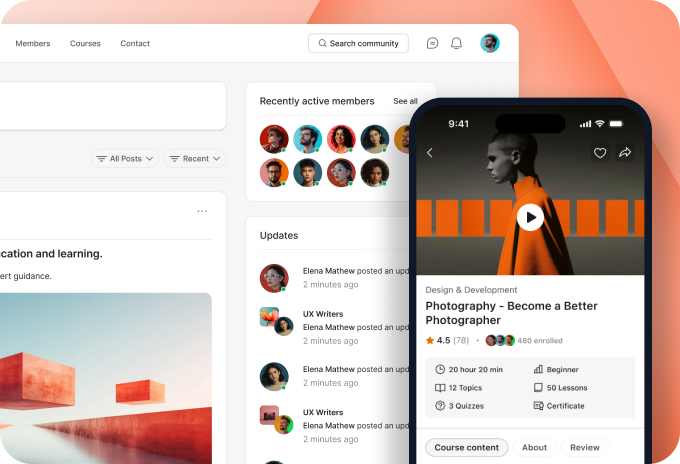













Thinkific is one of the most popular course platforms for a reason. Clean course builder, solid lesson formats, and 0% transaction fees on paid plans when using Thinkific Payments. For straightforward course delivery, it gets the job done.
But Thinkific was built for courses, and that focus has a cost:
- Community features that don’t go beyond a basic discussion layer
- No branded mobile app at any price point
- A 10,000 student cap on every plan
- A platform that starts to feel limiting once your business grows beyond straightforward course delivery
If you’re at that point, here are six Thinkific alternatives worth serious consideration, each solving a different problem Thinkific doesn’t.
Why People Leave Thinkific
Community Features Are Too Basic: Thinkific’s community is a discussion layer bolted onto courses, not a real social platform. No groups, no activity feeds, no direct messaging. For creators who know what genuine community does for retention, it’s a ceiling rather than a foundation.
No Branded Mobile App: Thinkific does not include a branded mobile app on any plan. It is available as a $199/month add-on, not a standard feature. Students on standard plans access courses through Thinkific’s generic app alongside every other Thinkific school.
The Hidden Fee on Stripe: Thinkific’s 0% transaction fee only applies when using Thinkific Payments. Use your own Stripe account and you’re paying a surcharge of up to 5% depending on your plan. For creators already set up on Stripe, that’s an unexpected cost that changes the pricing math considerably.
The 10,000 Student Cap: Every Thinkific plan caps you at 10,000 active students. For most creators starting out it feels out of reach. For growing course businesses, it’s a hard ceiling that eventually forces a platform decision you didn’t plan for.
Pricing Scales Quickly: Live lessons, advanced communities, memberships, and cohort delivery are all locked behind higher tiers. By the time you have the feature set you actually need, you’re paying more than purpose-built alternatives that do those things better.
6 Best Thinkific Alternatives for 2026
Here are six Thinkific alternatives worth serious consideration in 2026, each stronger in the areas where Thinkific falls short.
1. BuddyBoss + LearnDash — Best for Community + Courses with Ownership
Pricing: BuddyBoss Pro at $299/year plus LearnDash. 0% transaction fees.
Best for: Course creators who want deep community features alongside courses, no student cap, a white-label mobile app option, and full ownership of their platform and data.
If Thinkific’s community limitations are the primary reason you’re looking elsewhere, BuddyBoss is the most complete answer on this list. Where Thinkific gives you a basic discussion layer, BuddyBoss gives students a real social experience: activity feeds, member profiles, direct messaging, interest-based groups, and gamification with points, badges, and leaderboards.
The course delivery side is handled through LearnDash, one of the most advanced WordPress LMS plugins available, with drip content, eight quiz types, certificates, assignments, and SCORM support. Combined with BuddyBoss’s community layer, you get a platform that solves every major gap Thinkific leaves open, deeper community, better course tools, branded mobile app options, and no student cap at any level.
The cost difference is significant too. BuddyBoss at $299/year is considerably cheaper than Thinkific’s mid and upper tiers, with 0% platform fees and no ceiling on how many students you can enroll.
Honest limitations: BuddyBoss runs on WordPress, which means managing hosting, updates, and plugins. There are no built-in email marketing or landing page tools. You’d integrate those separately through WordPress plugins or a standalone tool like ConvertKit.
2. Teachable — Simplest SaaS Alternative
Pricing: $29/month (Starter, annual billing). Transaction fees: 7.5% on Starter, 0% on Builder and above.
Best for: Early-stage creators who want the simplest possible course setup and sell coaching alongside courses, and aren’t looking for community features.
Teachable is worth considering as a Thinkific alternative if your primary need is the simplest possible course setup. The course creation experience is clean and beginner-friendly, and coaching products, one-on-one sessions sold alongside courses, are handled more elegantly on Teachable than on Thinkific. If that’s a core part of your business model, it’s a meaningful differentiator.
On community and features though, Teachable doesn’t solve Thinkific’s core weaknesses. Community features are even more minimal than Thinkific’s. There’s no social layer, no groups, and no member profiles. If community depth is why you’re leaving Thinkific, Teachable isn’t the answer.
Where Teachable does offer a genuine improvement is simplicity. If you find Thinkific’s configuration options overwhelming and just want to get a course live with minimal setup, Teachable gets you there faster.
Honest limitations: The 7.5% transaction fee on the Starter plan is the highest in the market. You’d need to be on Builder at $69/month to eliminate it. Community features are minimal, less than what Thinkific already offers.
3. Kajabi — Best for Marketing + Courses All-in-One
Pricing: $143/month (Basic, annual billing). 0% platform transaction fees when using Kajabi Payments.
Best for: Solo course creators who want to consolidate courses, email marketing, and sales funnels into one platform and have the budget for the convenience.
Kajabi solves a different problem than Thinkific. Where Thinkific is a course platform that requires you to integrate separate tools for email marketing, landing pages, and sales funnels, Kajabi brings all of that under one roof. If you’re currently running Thinkific alongside a separate email platform and landing page builder, Kajabi can replace that entire stack with a single subscription.
On the community side, Kajabi does offer more than Thinkific, but it’s worth being honest about the comparison. Community features are available on all plans but basic across all tiers. More developed community tools are on the Growth plan and above. And even then, Kajabi’s community is a step up from Thinkific’s basic discussion layer but falls well short of what BuddyBoss or Mighty Networks deliver. You’re paying for the all-in-one marketing toolset, not for community leadership.
The price jump from Thinkific is significant. Kajabi Basic at $143/month is more expensive than Thinkific’s entry plan, and you need Growth at $199/month to unlock community features. The premium is partially justified if Kajabi replaces tools you’re already paying for separately. If you’re just looking for better community depth, there are cheaper ways to get it.
Honest limitations: Most expensive SaaS option on this list. Community features require the Growth plan. Kajabi raised prices significantly in January 2026, so verify current rates before committing.
4. Circle — Best for Courses Inside a Real Community
Pricing: $89/month (Professional, annual billing). Transaction fees of 0.5% to 2% depending on plan.
Best for: Course creators who want genuine community depth in a polished SaaS environment and are comfortable with transaction fees and a modular pricing structure.
Circle is the strongest SaaS Thinkific alternative if community depth is the primary reason you’re leaving Thinkific. Where Thinkific treats community as an add-on to courses, Circle treats community as the core product and adds courses on top. You get threaded discussion spaces, rich member profiles, live streams, live rooms, events, gamification, and paid memberships, all in a polished interface that feels purpose-built for engagement rather than content delivery.
The course tools on Circle are solid for most creators. You can sell courses, gate content behind memberships, and run live workshops inside the same platform your community lives in. The integration between community and courses feels native in a way Thinkific’s never does.
A few things worth knowing before you switch. Circle charges transaction fees on every plan, ranging from 2% on Professional down to 0.5% on Enterprise. Email marketing is not included and costs an additional $99/month as an add-on.
Branded mobile apps require Circle Plus, which is custom-priced. And if you need automation workflows and API access, you’re looking at the Business plan at $199/month rather than the entry Professional plan.
Honest limitations: Transaction fees on every plan with no path to zero on standard tiers. Email marketing costs extra. Branded mobile apps require custom pricing. Certificate issuance requires a third-party integration.
5. Mighty Networks — Best for Community-First with Courses
Pricing: $79/month (Launch, annual billing). Transaction fees from 2% on Launch, never reaching 0% on any standard plan.
Best for: Creators who want community depth, live teaching, and cohort courses in a fully managed SaaS environment, and are comfortable with ongoing transaction fees.
Mighty Networks is another closest SaaS competitor to BuddyBoss on community depth. Where Thinkific gives you a basic discussion layer, Mighty Networks gives you spaces for different topics and groups, cohort-based courses where students move through content together, live streaming, events, and native iOS and Android apps from the Scale plan. Community is genuinely central to how the product is designed, not an afterthought added to a course platform.
The cohort course model is a particular strength. If you run group programs, live cohorts, or time-bound learning experiences where peer interaction drives most of the value, Mighty Networks handles that better than any other SaaS platform on this list. Students don’t just consume content in isolation, they move through it together in a structured social environment.
The concerning part is transaction fees that never fully disappear. At 2% on Launch, 1% on Scale, and 0.5% on Growth, every plan carries a platform fee on top of standard payment processing costs. A fully white-labeled native mobile app with your own name in the app stores requires Mighty Pro, which starts at roughly $33,000/year.
Honest limitations: Transaction fees on every plan with no path to zero. White-label mobile app requires Mighty Pro at enterprise pricing. Customization is more limited than WordPress-based options.
6. Skool — Cheapest Gamified Community + Courses
Pricing: $9/month (Hobby) or $99/month (Pro, monthly billing). Transaction fees: 10% on Hobby, 2.9% on Pro through Skool’s native payment processor.
Best for: Early-stage creators who want gamified community alongside simple course delivery, and value organic discovery through Skool’s marketplace.
Skool takes the opposite approach to Thinkific. Where Thinkific leads with course delivery and adds a basic community layer, Skool leads with community and keeps the course tools deliberately simple. The interface is minimal by design: a community feed, a classroom tab, a leaderboard, and not much else. For some creators, that simplicity is exactly what they need.
The gamification features are Skool’s genuine differentiator over Thinkific. Points, leaderboards, and unlockable content tied to course progress create competitive motivation that flat course completion simply doesn’t. Students show up more consistently when there’s a social element to their progress. For community-driven learning, that’s a meaningful engagement lift.
Skool’s marketplace is another advantage Thinkific can’t match. Every Skool community is searchable and browsable by all Skool users, giving early-stage creators a real organic discovery channel that most platforms don’t offer at any price point.
The watch-out is the Hobby plan’s 10% transaction fee. It looks like a bargain at $9/month until you start generating real revenue. At $3,000/month in sales that’s $3,600/year in fees alone. Anyone selling meaningful volume should be on Pro, not Hobby.
Honest limitations: No mobile app. No meaningful customization, every Skool community looks like every other. Course tools are basic compared to Thinkific. Hobby plan’s 10% fee is punishing at any real revenue level.
How the Platforms Compare on Community, Features and Value
Community depth is where Thinkific falls shortest, but it’s not the only dimension worth comparing. Here’s how each platform stacks up across the features that matter most for course creators evaluating their options.
How to Choose Your Thinkific Alternative
The right alternative depends on what’s driving you away from Thinkific and what you’re building toward.
If community depth is the primary reason you’re leaving, BuddyBoss is the strongest choice at the lowest cost. Deep social features, groups, activity feeds, direct messaging, and gamification, all at $299/year with no student cap and no platform fees.
Circle is the best SaaS alternative for community depth, with polished spaces, live streams, and gamification in a managed environment. Mighty Networks is the right call if you specifically want cohort-based courses and live teaching alongside community, and are comfortable with ongoing transaction fees.
If you want an all-in-one platform that replaces Thinkific and your email marketing tool in a single subscription, Kajabi is the only option on this list that does that well. The premium is significant but partially justified if it eliminates tools you’re already paying for separately.
If simplicity is the priority and you just want a cleaner course setup without Thinkific’s limitations, Teachable is the most beginner-friendly swap. Just be aware that community features are even more minimal than Thinkific’s.
If you’re at an early stage and want to test a community-driven course idea at the lowest possible cost, Skool’s $9/month Hobby plan gets you started quickly. The gamification and marketplace discovery are genuine advantages at that stage. Just move to Pro before you start generating meaningful revenue.
If technical setup is a concern, Circle, Mighty Networks, Kajabi, Teachable, and Skool are all fully managed SaaS with no server or plugin management required. BuddyBoss runs on WordPress, which adds some technical involvement but significantly lowers your long-term platform costs.
Frequently Asked Questions
What is the best Thinkific alternative for community?
BuddyBoss is the strongest alternative for community depth alongside courses. Social profiles, activity feeds, groups, direct messaging, and gamification at $299/year with 0% platform fees and no student cap. Circle is the best SaaS alternative for community depth, with polished spaces, live streams, and gamification in a fully managed environment. Mighty Networks is the right call if you specifically want cohort-based courses and live teaching woven into your community. All three are significantly better than Thinkific for community-first learning.
Is BuddyBoss better than Thinkific?
For community-focused course businesses, yes. BuddyBoss has deeper community features, no student cap, white-label mobile apps, and costs considerably less than Thinkific’s mid and upper tiers. BuddyBoss runs on WordPress, which means managing hosting and plugins. If zero technical involvement is a priority, Thinkific’s managed SaaS setup is simpler. But on community depth, features, and long-term value, BuddyBoss wins decisively.
Does Thinkific have good community features?
No. Thinkific’s community is a basic discussion layer with one community space per course on the entry plan. There are no social profiles, no member-to-member messaging, no groups, and no gamification. It works for simple Q&A around course content but falls well short of what purpose-built community platforms deliver. If community engagement is important to your business, Thinkific’s community tier is a ceiling regardless of which plan you’re on.
What is cheaper than Thinkific?
Most options on this list. BuddyBoss at $299/year, Skool’s Hobby plan at $108/year, and Circle’s Professional plan at $1,068/year are all cheaper than or comparable to Thinkific’s entry price of $888/year. Skool’s Hobby plan looks cheapest by license price but the 10% transaction fee makes it expensive at any meaningful revenue. BuddyBoss at $299/year is the most cost-effective option once you factor in community features and no student cap.
Can WordPress replace Thinkific?
Yes, and for most established creators it delivers more. BuddyBoss on WordPress replicates everything Thinkific offers and adds features Thinkific doesn’t, including deep community tools, member-to-member messaging, groups, gamification, and a white-label mobile app option. For creators who want predictable costs, no student cap, and a genuine community layer, WordPress consistently delivers better long-term value.
Make the Switch
Pick the platform you’d be comfortable on in three years, not the one that’s easiest in week one. Thinkific is easier to start. BuddyBoss is easier to stay on. For most creators reading this far, the second one matters more.
