














Membership retention strategies matter more than most owners admit. Most spend their energy on getting new members through the door: more traffic, more ads, more launches. Then members quietly cancel, and the growth you worked for leaks out the back.
That is a retention problem, not a growth problem. A widely repeated rule of thumb, often attributed to Harvard Business Review, says acquiring a new customer costs anywhere from 5 to 25 times more than keeping an existing one. The exact multiple varies by business, but the direction is hard to argue with. When someone cancels, you lose their monthly fee and the acquisition cost you already spent to win them.
This guide covers 12 membership retention strategies, organized by where members are in their journey, from the critical first 30 days through long-term loyalty. Each strategy includes a real example and a concrete step you can take this week.
Why Members Leave
Before you can fix retention, you need to understand why members leave. If you are not asking cancelling members why, you are guessing, and guessing leads to fixes for the wrong problem. Most owners assume the content was not good enough or the price was too high. In practice, exit surveys tend to surface a handful of recurring reasons:
They consumed everything too fast.
They binged the content, got what they needed, and saw no reason to stay. If your value is front-loaded, your churn will be too.
The price stopped feeling worth it.
Members rarely cancel because something costs money. They cancel when the cost exceeds the perceived value. If they are not logging in, not seeing results, or not connecting with other members, even a modest monthly fee starts to feel wasteful.
Their payment failed and no one followed up.
This one is painful because it is preventable. Expired cards, declined transactions and billing errors cause involuntary churn. Payment-recovery vendors such as Recurly put it at roughly 20 to 40 percent of churn in subscription software, and your own number will differ, but it is rarely zero. These members did not choose to leave.
They never felt like they belonged.
Content keeps people interested. Community keeps people subscribed. Members who do not connect with others through forums, groups or live sessions have fewer reasons to stay once the content runs out.
There was no clear “what’s next.”
After onboarding or a finished course, many members hit a wall. No guidance and no path forward leads to disengagement, and disengagement leads to cancellation.
Life got in the way.
Budgets tighten and priorities shift. You cannot control that, but you can make it easy to pause instead of cancel, and stay in touch until they are ready to return.
How to Calculate Your Membership Retention Rate
Not measuring retention means making decisions without real numbers. Retention rate tells you what percentage of members stuck around over a specific period. Use this formula:
Retention Rate = ((E – N) ÷ S) × 100
- E = Members at the end of the period
- N = New members added during the period
- S = Members at the start of the period
Quick example: You start January with 200 members. During the month, 40 new members join, and you end January with 210. ((210 – 40) ÷ 200) × 100 = 85% retention. That means 15% of your starting members left.
What counts as a good rate depends on your model, price point and billing period, so there is no single industry benchmark. A more useful habit is to track the number monthly, compare it against your own trend, and watch what happens after each change you make. For other numbers worth tracking alongside it, see our guide to community health metrics.
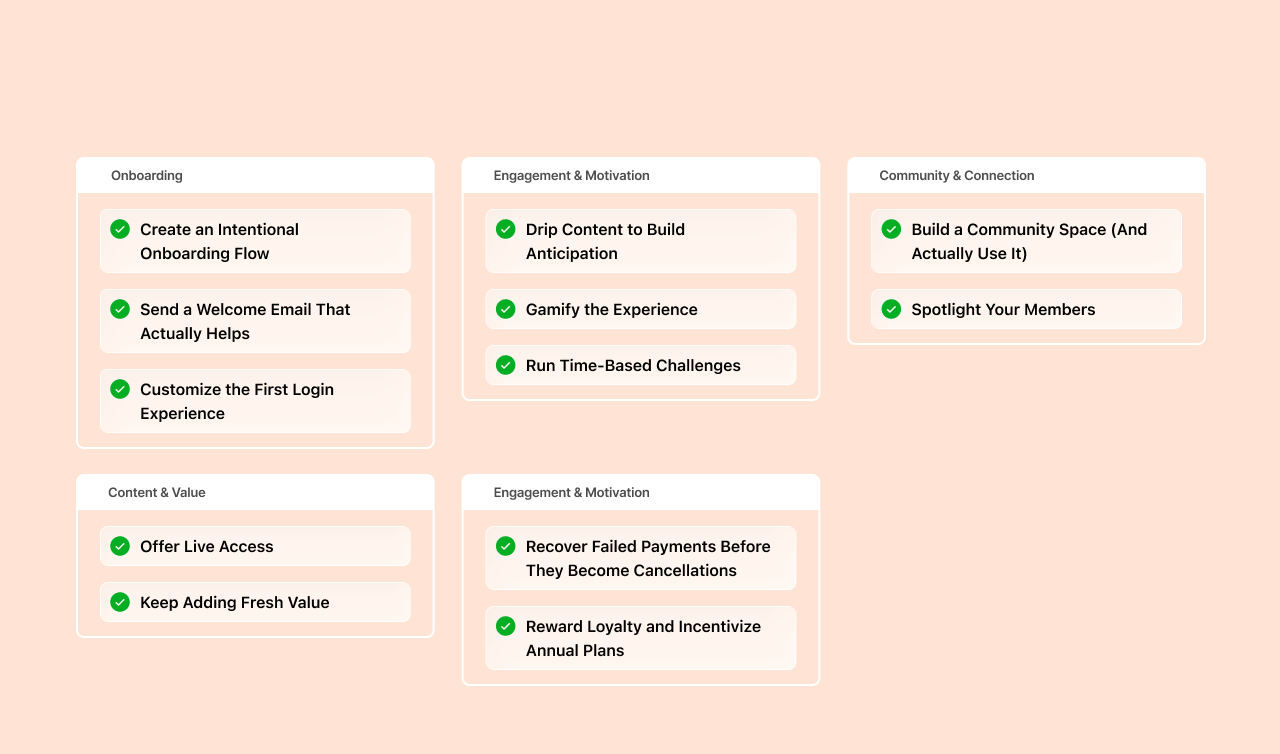
12 Membership Retention Strategies That Actually Work
Retention does not happen by accident. You build it into every stage of the member journey, from the moment someone signs up to the day they hover over the cancel button. If you already know where you are losing people, start in that section. If you are not sure, work through them in order.
A: Smart Onboarding (First 30 Days)
The first 30 days set the pattern. Members who engage early tend to stick around. Members who feel lost or overwhelmed quietly disappear. Most membership sites put their effort into getting people in the door and forget to show them around once they are inside.
Strategy 1: Create an Intentional Onboarding Flow
A common mistake is unlocking the entire content library on day one and expecting new members to figure it out. They log in, see dozens of courses and hundreds of videos, freeze, and leave. New members need a clear path: a welcome sequence, an orientation course or a simple checklist that says “start here, do this, then do that.” Your job is to get them to a first win as quickly as possible.
Melissa Ramos, who runs a hormone-health membership for women, shared her story in an AccessAlly case study. Her monthly churn ran at roughly 12 to 15 percent while content was available all at once. After she moved to a structured path that drips weekly over about nine to twelve months, churn fell to around 5 percent. A platform change was part of that story, so the drip was not the only variable, but the structure was central to it.
It is not just an online membership lesson. A large YMCA in the southern United States introduced a structured onboarding program for new members in 2016, and its 13-month retention rose from 68 to 72 percent, according to a MobileFit case study.
Make it actionable: Build a “Start Here” course or checklist that guides members through their first 7 to 14 days. Do not give them everything at once. Give them a path.
Strategy 2: Send a Welcome Email That Actually Helps
Most membership welcome emails say some version of “Thanks for joining! Here’s your login.” That is a wasted opportunity. Welcome emails are among the most-read emails you will send, so use that attention: give members one clear next step, link to your most valuable resource, and point them toward a quick win.
Email marketing roundups, such as WordStream’s, have long reported welcome emails earning several times the open and click rates of regular campaigns. Treat the exact multiples as directional, since results depend on your list, but the pattern is consistent.
In a 2012 MarketingSherpa case study, the parenting site SavvyMom replaced a single generic welcome email with a three-email sequence sent 10 days apart. The emails thanked and oriented new subscribers, highlighted key content, and encouraged deeper engagement. The result was a 450 percent increase in unique click-through rate. It is an older example, but the principle still holds.
Make it actionable: Write a welcome email with one specific action, not three or five. Tell new members exactly where to go and what to do first, and send it immediately after signup.
Strategy 3: Customize the First Login Experience
First-time members should not see the same screen as returning members. A new member is asking “where do I start?” while a returning member is asking “what’s new?” Those are different questions, and your site should answer them differently. A login redirect that sends new members to a welcome page or onboarding flow instead of a cluttered dashboard removes friction and makes the experience feel personal from the first click.
Canva is a well-known example. It asks new users what they want to make, such as social graphics, presentations or marketing materials, and then adjusts the templates and tutorials it shows first. Canva reported more than 265 million monthly active users at the end of 2025. We can’t say how much of that comes from onboarding, but the approach is a useful model: show each person what is relevant to them first.
Make it actionable: Set up a first-login redirect that sends new members to a welcome page or onboarding module, not your full library. Consider adding one question (“What’s your goal?”) to personalize what they see next.
B: Engagement and Motivation
Onboarding gets members started. Engagement keeps them coming back. Months two and three are often the danger zone: the honeymoon is over, life gets busy, logins drop, and members start asking “why am I still paying for this?” The goal of these strategies is to keep them from ever reaching that question.
Strategy 4: Drip Content to Build Anticipation
Releasing all your content at once feels generous, but it can work against retention. Bingers consume everything in a week and cancel, while everyone else is overwhelmed by the volume and engages with nothing. Releasing lessons, modules or resources on a schedule gives members a reason to come back next week and creates anticipation instead of overwhelm.
Whole30, the nutrition program, is built around a structured 30-day program with daily guidance, recipes and tips rather than a single dump of information. Participants always have a next step, and that rhythm is a big part of the program’s appeal.
Make it actionable: Set up a drip that unlocks new material weekly or monthly. Even one resource per week keeps members engaged longer than dumping everything on day one.
Strategy 5: Gamify the Experience
Points, badges, leaderboards and progress bars work because they tap into how people are wired: we like earning things, seeing progress and a little friendly competition. Gamification is a proven way to nudge activity, and you do not need a complex system to start. Progress tracking that shows members how far they have come, badges for milestones and recognition for consistent engagement go a long way. Even “You’ve completed 5 of 12 modules” gives members a reason to keep going. If you run your community on BuddyBoss, our guide to gamification setup for communities walks through it.
Duolingo is the best-known example. Its streak counter and XP points are central to how the product keeps people returning daily, and many users describe real reluctance to break a streak.
Research supports the idea that game elements move behavior, with caveats. An academic study of Fitbit users found that adding leaderboard-style social features increased activity by about 3.5 percent overall, and by about 15 percent among users who had been the most sedentary. In other words, gamification helps most for the people who most need a nudge. KFC’s gamified loyalty program in the UK and Ireland, reported by Antavo, drove a 53 percent increase in app downloads, and 31 percent of surveyed customers said they used the app more.
Make it actionable: Start with visible progress and one or two milestone badges. Add streaks or leaderboards only once you see members respond.
Strategy 6: Run Time-Based Challenges
If you pick one strategy that delivers the most return for the effort, this may be it. A 7-day challenge, a 30-day transformation or a quarterly sprint creates urgency, community and momentum all at once. Members get a specific goal with a deadline, plus a shared experience with others working toward the same thing.
Yoga with Adriene has built an audience around this format, releasing a free yoga series every January that viewers follow along with day by day. They are simple videos with a clear structure, but the format turns casual viewers into people who come back year after year.
Challenges also re-engage members who have gone quiet. Someone who has not logged in for two months may show up for a fresh challenge, because it is a reason to return without feeling behind.
Make it actionable: Plan one challenge per quarter with a clear goal, a defined timeframe, community participation and recognition for those who finish.
C: Community and Connection
Content keeps members interested, but community keeps them loyal. Members who only consume content treat your site like a streaming service: useful until something better shows up. Members who build relationships treat it like a neighborhood, and leaving means losing people they care about.
Strategy 7: Build a Community Space (and Actually Use It)
A forum, a group, a dedicated community space: whatever you call it, giving members a place to connect with each other is one of the highest-leverage retention moves available. When members talk to each other, they are paying for belonging, not just content, and belonging is sticky in a way content alone is not.
Sephora’s Beauty Insider Community launched in August 2017 as a place for members to ask questions, share looks and review products. According to Modern Retail, Sephora’s roughly 40 million Beauty Insider members now drive a majority of its sales. Not all of that comes from the community, but it shows how a program built around belonging can anchor a business.
Make it actionable: Create a dedicated community space, whether on your own site or elsewhere, and then show up consistently. A dead forum is worse than no forum. For ideas on how to keep one active, see our guide to community health metrics.
Strategy 8: Spotlight Your Members
Recognition is one of the most underused retention tools, and it costs almost nothing. The featured member feels valued and connected. Everyone else sees proof that results are possible and that the community notices and celebrates success.
Amanda Schonberg, who runs a paid community for baking business owners, invites members who complete her sales challenge to appear as guests on her podcast. The featured member gets recognition they can share with their audience, other members see that the strategies work, and everyone has a reason to push harder for the spotlight.
You do not need a podcast. A weekly email featuring a member win, a “Wall of Fame” page or a monthly “Member of the Month” post in your community creates the same effect.
Make it actionable: Create a recognition calendar. Feature one member story per week or month, and make submissions easy with a simple form.
D: Content and Value
Members stay when they believe they are getting more than they are paying for. That belief is not automatic. It erodes over time if you do not reinforce it, because content that felt valuable in month one feels familiar by month six. You need to keep delivering reasons to stay.
Strategy 9: Offer Live Access
Recorded content is valuable. Live access is harder to replace. Q&A calls, office hours, group coaching and workshops give members something they cannot get anywhere else, which is direct interaction with you. They also create urgency: miss the call, miss the moment.
Pencil Kings, a membership for artists, combines an on-demand course library with live workshops and coaching sessions. The live component turns passive consumption into participation: members get feedback, ask questions and connect with instructors in real time.
Live does not have to mean weekly. Monthly office hours or quarterly workshops can still create anticipation and strengthen connection.
Make it actionable: Schedule one recurring live event, whether a monthly Q&A, biweekly office hours or a quarterly workshop. Record it for members who cannot attend, but promote the live experience as the main draw.
Strategy 10: Keep Adding Fresh Value
A static membership is a shrinking one. Members who joined for your current content will eventually finish it, and if nothing new appears, they will question why they are still paying. New content, features or expanded benefits show members that their subscription is a growing investment. If you are still deciding what belongs behind the paywall, our guide to membership level ideas can help.
Netflix is the extreme case: it spends on the order of 20 billion dollars a year on content in 2026, much of it on originals, specifically so the library keeps giving subscribers a reason to stay. Amazon Prime takes a different route by stacking benefits. It started as a shipping program and now bundles streaming, music, gaming perks and more, so each addition makes cancelling feel like giving up a little more.
You do not need Netflix’s budget. A new mini-course every quarter, monthly expert interviews or regular feature improvements all signal that the membership is alive and evolving.
Make it actionable: Build a content calendar with at least one fresh addition per month, and tell members about each update so they notice the ongoing investment.
E: Retention and Renewal
The strategies above keep members engaged. These last two keep them subscribed when things go wrong, because sometimes the issue is not engagement at all. It is a billing hiccup or a missing incentive to commit long term.
Strategy 11: Recover Failed Payments Before They Become Cancellations
Some members are not choosing to leave at all. Their card expired, a payment declined, or the bank flagged a transaction. If you do not follow up, they are gone, not because they wanted to cancel but because they slipped through the cracks.
Payment-recovery vendors say the problem is large. FlexPay, which specializes in this, claimed in a 2021 report that payment failures can account for up to 48 percent of subscription churn, and treat that as a vendor estimate rather than a universal number. The upside is documented too: restaurant software company Zenchef used automated dunning with Chargebee and recovered 60 percent of formerly unpaid accounts, without a single support ticket or cancellation request.
The fix is to automate recovery: retry failed payments, send a friendly email asking members to update their card, and make that update one click. Check what your payment gateway and membership or subscription plugin support, since retry rules and email templates vary by tool.
Make it actionable: Turn on automatic payment retries and set up a failed-payment email sequence. Keep the tone helpful, not punishing, and include a clear link to update billing details.
Strategy 12: Reward Loyalty and Incentivize Annual Plans
Monthly subscriptions are convenient, but they are also easy to cancel. Annual plans create commitment: when members pay upfront for a year, they are invested and have more reason to engage with what they bought. For membership sites, this can mean discounting annual plans (two months free is a common approach), offering exclusive perks for long-term members, or creating a VIP tier that unlocks with tenure.
Loyalty programs show how much recognition can matter. Starbucks reported that Rewards members accounted for 59 percent of U.S. company-operated store spending in the third quarter of fiscal 2026. Sephora’s Rouge tier, which requires $1,000 in annual spending, adds perks such as early access to products and exclusive events, and that exclusivity gives its top members a reason to keep engaging.
Make it actionable: Offer an annual plan at a discount, and add a loyalty perk at the 6-month or 12-month mark, such as exclusive content, a bonus resource or a “founding member” badge. Make staying feel rewarding.
Start Keeping More Members This Week
Chasing new members forever is exhausting and expensive. When you keep the members you already have, revenue becomes more predictable and your community grows stronger.
You do not need to implement all 12 strategies tomorrow. Pick one. Maybe it is fixing your welcome email, or setting up a community space. Whatever it is, start this week, and track your retention rate so you can see what moves it.
Ready to build a membership that keeps members coming back? Explore how BuddyBoss’s community features can help you create the connections that drive long-term retention.
