













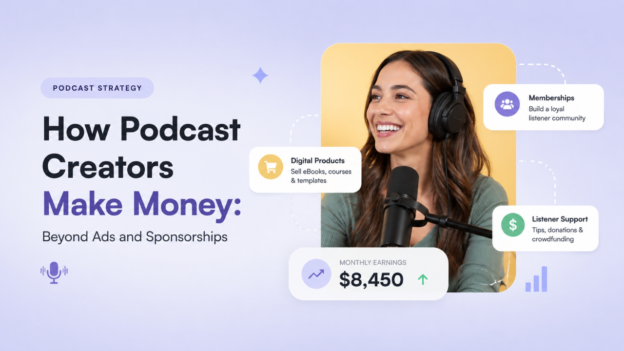
You’re getting a few hundred downloads per episode. Maybe a few thousand. Sponsorship inquiries are sporadic, rates are unclear, and the math doesn’t add up to a real income. You’re starting to wonder if podcast monetization actually works below a certain download threshold.
It does work. Just not through ads alone. Here’s every real monetization option for podcasters, what each one actually requires, and which model compounds instead of plateauing.
Podcast Sponsorships: What They Actually Pay
Sponsorships are measured in CPM (cost per mille, per thousand downloads). Advertisers pay a CPM rate, you run a pre-roll, mid-roll, or post-roll ad, and the sponsorship agency or brand pays out based on verified download counts.
Current benchmarks run roughly $15-30 CPM for pre-roll, $25-40 CPM for host-read mid-roll (the highest-value placement, since listeners are already engaged by that point), and $10-20 for post-roll. Finance, business, and tech shows can command $40-100 CPM. Host-read ads pay more than dynamically inserted ones across the board.
The math at 1,000 downloads per episode: with a $25 mid-roll CPM, a single sponsorship earns you $25. Two sponsored ad slots gets you to $50 per episode. At one episode per week, that’s $200/month. That’s not income. That’s a rounding error.
Going direct to brands, most advertisers want at least 2,000-5,000 downloads per episode before they’ll talk to you. Below that, sponsorship networks built for smaller shows (Podcorn, AdvertiseCast) will work with shows as small as 500 downloads, though the rates are lower and less predictable than a direct deal.
The Inconsistency Problem
Sponsorships aren’t a salary. A sponsor signs on for a campaign run of 4-8 weeks, then it ends. You go back to outreach. Some months you have two sponsors. Some months you have none. If you go on vacation and skip two episodes, your download count drops and your next pitch is weaker.
Podcast sponsorships are a real revenue stream at scale. Below 10,000 downloads per episode, they’re supplemental at best.
Premium Podcast Feeds
Platforms like Supercast and Supporting Cast let you offer a paid private RSS feed. Subscribers pay a monthly fee to get ad-free episodes, bonus content, early access, or extended interviews. The audience subscribes via a private feed URL that plays in any podcast app they already use.
This is a genuinely good model for podcasters. It requires no new platform. Your audience doesn’t change their listening behavior. You just gate some content behind a paywall.
Supercast charges a per-subscriber fee rather than a percentage of revenue: $0.59/subscriber/month, plus Stripe processing (2.9% + $0.30) and a 0.7% surcharge on recurring payments, or 15% capped at $1.50 on one-time payments. That structure gets more economical as your subscriber count grows, but it’s a real cost at small scale. Supporting Cast prices differently again, so check its current rates directly before you compare.
The limitation is community. A premium RSS feed delivers audio. It doesn’t create connection between subscribers, it doesn’t enable conversation, and it doesn’t build the kind of ongoing relationship that drives high LTV. Churn on premium feed subscriptions tends to be higher than churn on community memberships because the value proposition is content access, and listeners can always find other content.
Patreon for Podcasters
Patreon is where many podcasters start with membership. It’s easy to set up, the audience has been conditioned to support creators there, and it handles recurring billing.
As of August 2025, Patreon moved to a flat 10% platform fee for new creators, while creators whose pages predate that change may still be on legacy tiers. You also pay payment processing on top, typically 2.9% + $0.30 per transaction in the US.
The deeper problem with Patreon is what it doesn’t offer. Patreon is essentially a billing layer with a basic content feed. There’s no real community infrastructure: no threaded discussion organized by topic, no member directory, no ability to host live events with proper tooling, no course delivery. What you get is a paywall and a post feed. For a fuller comparison, see our Patreon alternatives roundup.
Patrons who are paying $5-10/month for podcast bonuses churn when you stop posting. The value is entirely content delivery. There’s no community layer that creates retention independent of your posting cadence.
One-Time Products
Workshops, course recordings, transcripts, resource guides. These sell well to an existing podcast audience that already trusts you. The economics are excellent, since digital products have near-zero marginal cost once created.
The problem is one-time sales. Every sale requires a new customer, or a new product to sell to existing customers. You end up in a cycle of creating new products to generate new transactions. Revenue doesn’t compound.
One-time products work as upsells inside a membership model, not as the foundation of the business.
Community Membership: The Model That Compounds
Here’s what changes when you build a paid community layer on top of your podcast: you shift from selling content to selling connection and belonging. This is the same shift covered in our complete guide to monetizing a community.
Podcast listeners who are deeply engaged don’t just want more audio. They want to talk about what you discussed, connect with other people who think about the same problems, and access your knowledge directly rather than on your publishing schedule. A community gives them all of that.
A member who pays $29/month to be part of your community is worth $348/year. For example, if you build 200 paying members, that’s $69,600 annually. Add 300 more members and you’re at $174,000. This revenue doesn’t reset when you skip a week of episodes. It doesn’t require sponsor outreach. It builds on itself. (These numbers are illustrative, not a guarantee. Actual results depend on your pricing, niche, and conversion rate.)
What Podcast Listeners Actually Want From a Community
Podcast listener communities are different from newsletter reader communities or YouTube creator communities. Listeners develop a parasocial relationship with hosts over hundreds of hours of audio. They feel like they know you. What they want from a community reflects that.
They want direct access to you, not just to more of your content. Live Q&A sessions where they can ask you something directly are high-value. They want to know other people who listen. Podcast audiences tend to be self-selected and like-minded, and listeners are often looking for their people, not just your content. They want to go deeper on topics you cover in episodes: a forum organized by the themes of your podcast where the conversation continues after each episode is a natural fit.
This is fundamentally different from what drives, say, a newsletter community, where the relationship is more arm’s length and the value is information access. Podcast community members are investing in relationship, not just content.
Forum Structure for Podcast Communities
The community structure that works for podcasters: a general discussion space, topic-specific forums that mirror your podcast’s main themes, a member directory, and a dedicated space for episode-specific discussions, so members can react and expand on each episode after it drops. Live sessions, monthly Q&As and guest interviews conducted with member questions, are the highest-retention activity.
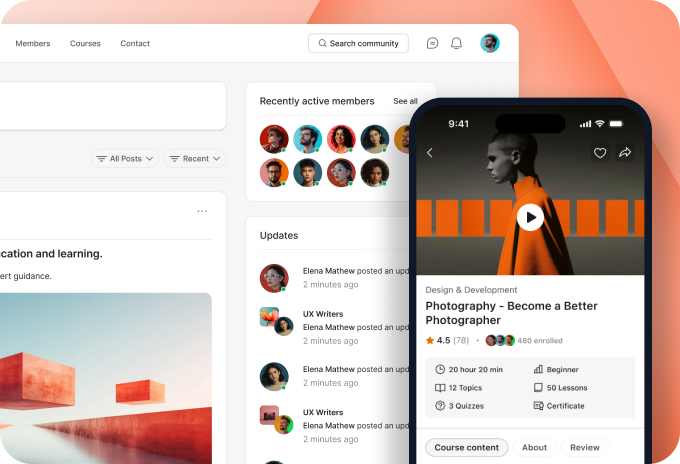
BuddyBoss handles all of this natively: member profiles, activity feeds, discussion groups, event hosting, and course delivery if you want to build structured educational content alongside your podcast. The platform sits on WordPress, so you own everything.
The Stack: Keep Your Podcast Host, Add a Community
You don’t replace your podcast infrastructure. You keep your existing podcast host (Buzzsprout, Transistor, Libsyn, whatever you use). Your public feed stays public. New listeners still find you through Apple Podcasts, Spotify, and YouTube.
The community runs separately on your own WordPress site, with membership tiers controlling who gets access to what. Paying members land in the right private space automatically, without you assigning roles by hand every time someone subscribes or cancels.
There’s no platform fee above standard payment processing. At $5,000/month in membership revenue, you pay Stripe’s processing rate and fixed WordPress hosting. On a platform charging a flat 10% fee, that same $5,000/month generates $500/month in fees, or $6,000/year. That’s money you keep instead.
Getting Your Podcast Audience Into the Community
The conversion path is direct. Mention the community consistently in your episodes. Give listeners a clear reason to join: access to you, access to each other, the extended conversation. Create a few pieces of member-only content that you reference publicly so non-members know what they’re missing.
Dedicated episodes about what’s happening inside the community, occasional “member spotlights” shared publicly, and visible community activity referenced in your podcast are all mechanisms for surfacing the community to your full audience and giving fence-sitters a reason to act.
Frequently Asked Questions
How many downloads do you need to make money podcasting?
For sponsorships, realistically 10,000 per episode before they amount to meaningful income, and most direct advertisers want to see at least 2,000 to 5,000 before starting a conversation. For membership, download count matters far less than engagement. A show with 800 highly invested listeners can out-earn one with 20,000 casual ones, because you are selling access and belonging rather than impressions.
How much do podcast sponsorships pay?
Rates are quoted per thousand downloads. Pre-roll typically runs $15 to $30, host-read mid-roll $25 to $40, and post-roll $10 to $20. Finance, business and tech shows command more, sometimes $40 to $100. The catch is the multiplication: at 1,000 downloads an episode, a $25 mid-roll pays you $25, so two slots weekly is around $200 a month.
Can you make money from a podcast without ads?
Yes, and for most shows it works better. The options are a paid premium feed, a membership or community, one-time products like workshops and courses, and direct listener support. Membership is the one that compounds, because revenue does not reset when you skip a week or when a sponsorship campaign ends.
Is Patreon good for podcasters?
It is a reasonable place to start and a poor place to stay. Setup is easy and listeners already understand it, but you give up a flat 10% as a new creator plus processing, and you get a paywall with a post feed rather than genuine community infrastructure. There is no topic-organised discussion, no member directory, no proper event tooling. That matters because content-only memberships churn whenever your posting slows down.
How do you get listeners to pay for a community?
Give them something the podcast cannot: access to you, and access to each other. Live Q&As where they can ask you directly, episode-specific discussion threads where the conversation continues, and a way to find other listeners who think about the same problems. Then make the community visible in the show itself, through member spotlights and references to what is happening inside, so the people on the fence can see what they are missing.
The Model That Doesn’t Reset Every Month
Sponsorships pay per download, which means your income resets to zero every time a campaign ends and drops every time you skip a week. Premium feeds are better, but they still sell content, and content-based subscriptions churn when the content slows.
A community is the only podcast revenue model where the thing people pay for keeps existing when you don’t publish. That is the whole difference between revenue that plateaus and revenue that compounds.
