












If you are billing by the hour or the session, your income has a ceiling. That ceiling is your calendar.
Most coaches hit it somewhere between $60,000 and $120,000 per year, depending on their rates. They are fully booked, clients are waiting, and the only path to more revenue is raising prices or adding hours. Neither scales.
The good news: the knowledge you are already selling in 1:1 sessions can be packaged, delivered at scale, and sold to hundreds of people simultaneously. The models below are not theoretical. They are what coaches and community builders are actually running right now.
Why 1:1 Coaching Does Not Scale
The math is simple and brutal.
If you charge $200 per session and work 30 sessions per week, your ceiling is $6,000 per week or roughly $300,000 per year before taxes, admin, and the burnout that comes with a full client load. Most coaches are nowhere near that number because the market for $200 sessions is smaller than it looks, and most people cannot sustain 30 coaching sessions per week without degrading the quality of every single one.
The model depends entirely on your time being present and available. Vacation, illness, parental leave, a slow month: all of these cut revenue directly.
A scalable model replaces the time constraint with a content and community infrastructure that delivers value while you sleep, travel, or take Fridays off.
Model 1: Group Coaching Program With Community
Instead of coaching one person for 60 minutes, you coach 10 to 20 people at once.
A group coaching program typically runs for a fixed term, 8 to 16 weeks, with weekly live calls and a private community for between-session support. Members get peer accountability alongside your expertise. You get revenue that does not multiply linearly with your hours.
At $500 per member for a 12-week group, a cohort of 15 people generates $7,500. Two cohorts per quarter is $15,000 from a program that runs three hours per week in live calls. The community handles a significant portion of the between-call support because members answer each other’s questions.
The community is not a bonus feature. It is the retention mechanism that makes people finish the program and buy the next one.
Model 2: Course Plus Community
An asynchronous course is the most familiar scalable model, but standalone courses have a completion problem. Most people who buy a course do not finish it. The ones who do finish are the ones who have someone to be accountable to.
Adding a community layer to a course changes the underlying incentive. A student stuck on a lesson has somewhere to ask. A student who finishes has people to tell. That accountability loop is the reason course-plus-community offers tend to outperform standalone courses on completion, even without a specific published benchmark to cite. Refund requests also tend to follow completion: students who make real progress rarely ask for their money back.
The model: sell the course as a one-time purchase or as part of a monthly membership. The community lives on your platform. Members work through the material at their own pace and get peer support in the forums.
A $497 course with an optional $47/month community add-on creates two revenue streams from one piece of content. The content cost is fixed. The community runs largely on member interaction.
Model 3: Paid Membership With Monthly Content
A membership is the most straightforward recurring revenue model. Members pay monthly or annually for access to a content library, a community, live sessions, or some combination.
The key variable is the value-to-churn trade-off. A membership with a content library and no community has high churn because members run out of content to consume. A membership built around community has lower churn because the value is in the relationships, which only exist as long as the membership is active.
The practical setup: one live Q&A call per month, a private forum or discussion space, a content library that grows over time. Members stay not because new content keeps dropping but because the community is where their peers are.
At $97/month and 100 members, that is $9,700/month in recurring revenue. Getting to 100 paying members is the hard part. Keeping them is a community design problem.
Model 4: Cohort-Based Program
Cohort programs are time-boxed, premium, and structured around a group that starts and ends together.
The cohort format works because it creates urgency (enrollment closes), accountability (everyone is at the same stage), and social proof (alumni from previous cohorts). It also commands a higher price than a self-paced course because the live interaction and cohort connection are genuinely more valuable.
Cohort programs in high-value coaching and professional development niches commonly charge in the $1,500 to $5,000 per participant range, though pricing varies significantly by niche and instructor reputation, so validate against comparable programs before setting your own. At 20 participants, one cohort per quarter at $2,000 per seat is $40,000 per quarter from a program you run four times per year.
The community platform hosts pre-work, discussion threads segmented by week, a directory so participants can connect outside sessions, and an alumni space that feeds future cohort referrals.
Model 5: Community-Led Events and Workshops
Events and workshops are not typically thought of as scalable, but virtual events have changed that calculation.
A virtual workshop priced at $47 to $197, marketed to your existing community, can generate significant one-time revenue with relatively low preparation time if you have already built the underlying content. A community of 500 active members is a captive audience for three to four events per year.
The community platform handles registration, pre-event discussion, post-event replay access, and ongoing conversation. Members who discover the community through a workshop often convert to ongoing memberships.
This model works best as a revenue layer on top of an existing membership, not as a standalone business. But it is a reliable source of revenue spikes that do not require new content to be built from scratch.
The Platform Math
Here is the conversation most coaches do not have until it is costing them real money.
SaaS community platforms take a percentage of your revenue. Mighty Networks charges 2% on its entry tier, dropping to 1% and 0.5% on higher tiers, but never reaching zero on any plan. Circle follows a similar pattern: 2% down to 0.5% depending on tier. At $1,000/month in membership revenue, Mighty Networks’ entry-tier 2% is $20. Irrelevant.
At $10,000/month, that same 2% is $200/month or $2,400/year. At $20,000/month, it is $4,800/year. That is a line item that grows automatically with your success, without you getting anything additional in return, and it never disappears even if you move to a higher tier, since the fee only drops, it doesn’t reach zero on either platform.
BuddyBoss runs differently: an annual site licence starting at $99/year (Start), $199/year (Launch), or $349/year (Scale), with 0% platform transaction fee on Launch and Scale. Your payment processor (Stripe) takes its standard processing fee regardless of which platform you use. On BuddyBoss’s Launch and Scale plans, nothing else comes off the top of your membership revenue.
This does not matter at month one. It matters a lot at month 24 when your community is generating $15,000/month and you are doing the math on what you are paying to live on someone else’s platform.
Why Owning the Platform Matters
At $5,000 to $10,000/month, the platform question shifts from preference to business decision.
On a SaaS platform, you are subject to their pricing changes, their feature decisions, and their policies. If the platform raises prices, you pay more. If they change the terms for payment processing, you adjust. If they get acquired or shut down, you rebuild.
On a self-hosted BuddyBoss install, your data lives on your server. Your member database is yours. Your content library is yours. The email addresses of every paid member are yours. If anything changes about the platform software, you have time to respond rather than scramble.
For a business generating real revenue, that ownership is not a philosophical preference. It is risk management.
Putting the Models Together
Most successful community businesses are not running just one of these models. They run a combination.
A common pattern: a free or low-cost entry community that converts to a paid membership, with cohort programs running twice per year as a premium upsell, and an annual event or workshop that reactivates lapsed members and generates publicity.
Each piece feeds the others. The free community builds an audience. The membership converts that audience to recurring revenue. The cohort upsell captures the members who want the highest level of engagement. The event creates a seasonal revenue spike and a recruiting moment for new members.
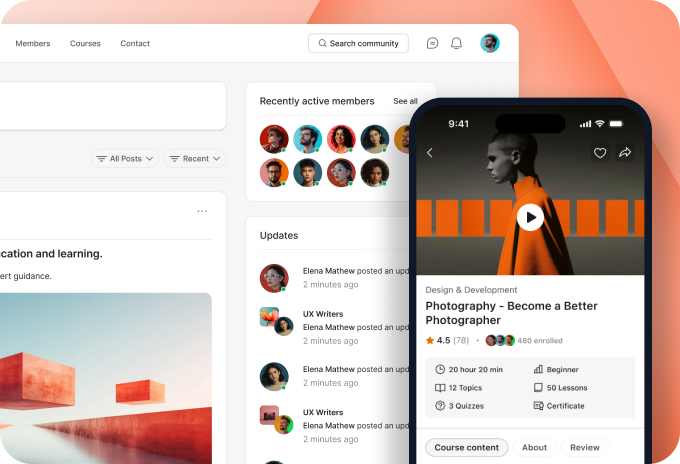
BuddyBoss supports all of these on one platform. Memberships and courses are built in natively, free on Launch and Scale, covering the group coaching, membership, and cohort-content delivery in Models 1 through 4 without a separate plugin. If you specifically need completion certificates for a cohort program, LearnDash integrates directly with BuddyBoss and adds that layer on top. Groups handle segmented communities, forums handle async discussion, member profiles handle networking, and direct messaging lets members connect one-to-one.
You are not stitching together five different SaaS tools. You are running one platform that you own. If your business leans more toward fitness or health coaching specifically, our guide to building an online fitness community walks through the same models applied to that niche.
Frequently Asked Questions
Which of these models should I start with?
Group coaching with community (Model 1) or a paid membership (Model 3) are the easiest entry points, since both can launch with content you likely already have from your 1:1 work. Cohort programs and large-scale events work better once you have an existing audience to sell into.
Do I need a separate course platform to run these?
Not necessarily. BuddyBoss now includes memberships and courses natively, free on Launch and Scale, which covers program delivery for most of the models above. LearnDash is worth adding specifically if you need completion certificates or more advanced course reporting.
How much does the platform fee actually cost me as I grow?
On a platform that charges a percentage of revenue, the fee grows automatically with your success and never disappears, even at the lowest available tier. On BuddyBoss’s Launch and Scale plans, there is no platform transaction fee at all, so growth doesn’t create a growing cost on top of your existing licence.
Can I run more than one of these models at once?
Yes, and most successful coaches do. A common combination is a paid membership as the base, with cohort programs run periodically as a premium upsell and occasional workshops to reactivate lapsed members. Each model feeds the others rather than competing for the same buyer.
Compare BuddyBoss plans and pricing against what a percentage-based platform would cost you at your current revenue.
