













I spent some time going through Reddit threads and creator forums before writing this guide to choosing a Substack alternative. I wanted to understand what people actually think about Substack, not the marketing version, the real one.
The praise is genuine.
Creators consistently say they do not regret starting on Substack. The writing experience is clean. Setup takes minutes. Your email list is yours to export whenever you want. And the recommendation network is real. Many writers report gaining hundreds of new subscribers purely through Notes engagement, no paid promotion required.
“I have over 30,000 subs on Substack. It’s like a blog and newsletter all in one. Plus you can get your content discovered on their platform and I can send out unlimited emails for free.”
u/MedalofHonour15 on r/Blogging
On Reddit, the sentiment is almost always the same: Substack is the easiest place to start, and for pure newsletter creators, it is still hard to beat.
But the complaints are just as consistent. Some creators are already bracing for the platform to change underneath them:
“I expect their user offering to deteriorate in the near future. Keep an eye out for a drift to the social media model with advertising, algorithms and a general walling off of the platform.”
u/jankydevin on r/Blogging
The 10% revenue share is manageable early on. At scale, it becomes a real number. Analytics are shallow. Automations are limited. And then there is the problem that most growing creators hit at some point:
Readers can reply to your posts. But they cannot talk to each other.
No groups. No member profiles. No spaces for discussion that exist outside of a comment thread. If you want to build something that feels like a community rather than a broadcast, Substack starts to feel like the wrong container.
There is also a subtler issue. The more you build on Substack (the Notes followers, the recommendation connections, the comment history), the harder it becomes to leave. That is not independence. That is soft lock-in dressed up as freedom. One commenter in that same thread put the alternative plainly:
“But if you want a tribe, and potentially a full-time career from this online business gig, invest in your domain and hosting to own the site.”
u/Reasonable_Copy7649 on r/Blogging
This guide is not about whether Substack is good. It is. For what it was built for.
It is about what to do when you have outgrown it. When the audience is there, the paid tier is running, and what is missing is the community layer to make all of it feel like something worth belonging to.
Here is how Ghost, Circle, and BuddyBoss compare as Substack alternatives, and how to figure out which move makes sense for you.
What Substack Does Well (And Where It Stops)
Substack is a genuinely excellent product for newsletter publishing. The writing experience is clean, the paid subscription infrastructure works out of the box, and discoverability on the Substack network gives new writers a real shot at early growth.
For pure newsletter creators, it is hard to argue against.
The limitations become visible when you want community. Substack’s discussion layer is built on post comments. Readers can reply to your writing, but they cannot start conversations with each other, form groups around specific topics, build relationships across posts, or access anything that looks like a member directory.
If your goal is a community, Substack is giving you a comment section. Those are very different things.
Who This Decision Is Really For
This comparison is not for writers who are happy with a newsletter. It is for creators who have noticed some or all of these signals:
Your readers are already trying to network with each other through the comments. You have launched a paid tier but struggle to justify the price beyond the writing itself. You want to offer courses, events, or resources alongside the newsletter. You are spending time managing community conversations across multiple platforms (Discord, Twitter, email) because Substack cannot hold them.
If any of those sound familiar, you have outgrown the tool. That is a good problem to have.
Substack vs the Alternatives: Four Platforms Side by Side
Substack
Best for: Newsletter-first creators who want simple monetization and built-in discoverability.
Community depth: Low. Comments per post, no member-to-member interaction outside replies, no groups, no member profiles.
Ownership: Limited. Your content lives on Substack’s infrastructure. You can export your subscriber list, but your community data, comment history, and community structure cannot move with you.
Pricing: Free to publish, with a 10% cut of paid subscriptions plus Stripe payment processing fees.
Ghost
Best for: Independent publishers who want a clean CMS and newsletter tool they can self-host or run on Ghost’s managed infrastructure.
Community depth: Low to medium. Ghost has native comments, and Ghost 6 added ActivityPub support that connects publications to the open social web. But there are still no forums, no groups, and no member-to-member profiles. It is fundamentally a publishing platform, and the community layer is thin.
Ownership: Better than Substack, especially if self-hosted. You control your data. The community features are still limited compared to dedicated community platforms.
Pricing: Ghost(Pro) plans start at $15/month billed annually, and paid memberships now require a higher tier. Self-hosted Ghost is free but requires technical setup.
Circle
Best for: Course creators and community builders who want a standalone community space with clean UX and no technical overhead.
Community depth: High. Circle offers spaces, member profiles, events, courses, and direct messaging. It also has its own native email marketing tool, Email Hub, rather than requiring a separate third-party integration, though it’s priced as an add-on: free under 100 contacts, then billed by contact count above that. It is purpose-built for community.
Ownership: Moderate. Circle is a hosted SaaS product. You do not own the infrastructure, and you are subject to their pricing and policy changes. Your data is exportable, but you cannot self-host Circle. We cover this in detail in our guide to the best Circle alternatives.
Pricing: The Professional plan is $89/month billed annually ($129 billed monthly), plus a 2% transaction fee on that tier, and Stripe processing applies on top.
BuddyBoss
Best for: Creators who want full ownership of their community infrastructure alongside newsletter, courses, and membership, all on their own WordPress installation.
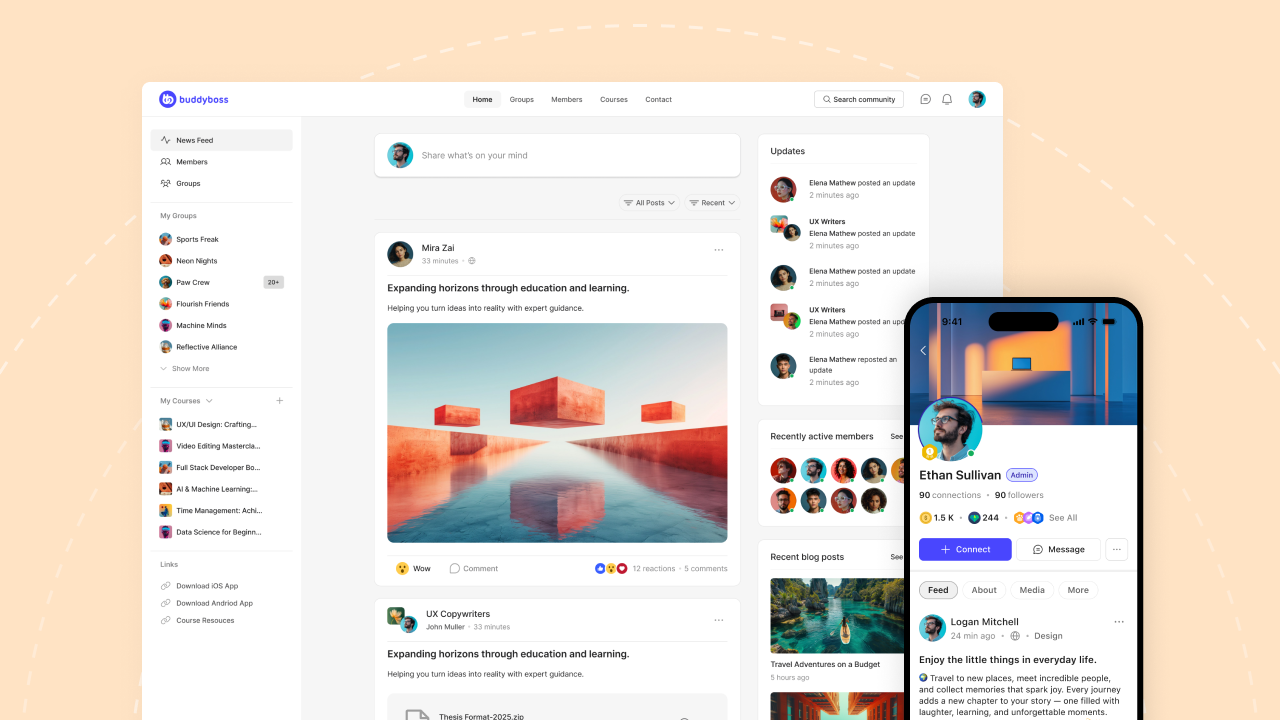
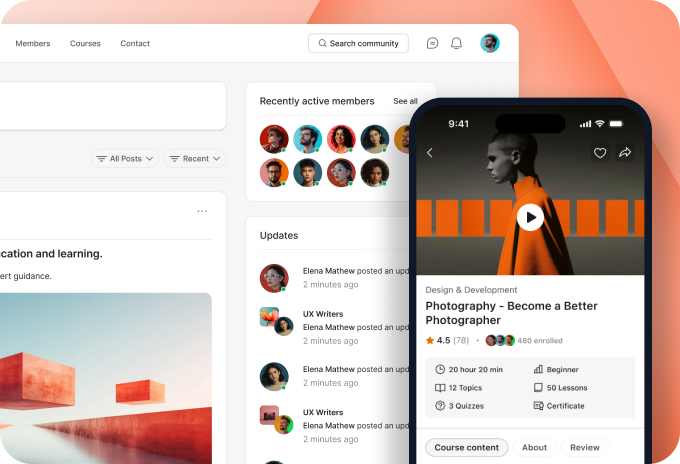
Community depth: High. BuddyBoss includes member profiles, activity feeds, groups, forums, direct messaging, and native gamification with points, badges and leaderboards on its top plan. Memberships and courses are built in, with lessons, quizzes and assignments, and it also integrates with LearnDash, LifterLMS and Tutor LMS if you already run one of those. It is built specifically for community-driven sites.
Ownership: Complete. BuddyBoss runs on WordPress, which you self-host. Your database, your community data, your member list, your content: all of it lives on infrastructure you control. There are no per-member fees, and on its main plans your payment processor’s cut is the only fee between you and your membership revenue.
Pricing: The core BuddyBoss Platform plugin is free. Paid plans add the BuddyBoss Theme, built-in memberships and courses, every LMS integration, and the optional mobile app builder; see the pricing page for current plans. Hosting costs vary based on provider and traffic. Email marketing runs through whichever tool you already use, connected via integration, rather than being built into the platform.
The Ownership Question Is Bigger Than It Looks
When a Substack writer moves their audience to a new platform, they can bring their email list. What they cannot bring is the community history: the conversations, the relationships between members, the context that makes a community feel alive.
If that community lives on a platform you do not own, you are building on someone else’s land. The platform can change its pricing, change its algorithm, change its policies, or change its focus. When that happens, your community has to move or adapt on someone else’s terms.
BuddyBoss is a WordPress plugin. Your community lives in your WordPress database, on your hosting account. You are not a tenant. There is no per-seat fee that scales with your growth, and your membership revenue runs through your own payment stack rather than a platform that takes a cut when a member upgrades.
For creators who have already proven they can build an audience, the ownership model starts to look very different than it did at launch.
What a Substack Creator Can Build on BuddyBoss
Here is a concrete example of what the migration to this Substack alternative looks like in practice.
You keep your newsletter workflow largely intact. BuddyBoss connects to the email tools you likely already use, such as Mailchimp, Kit (formerly ConvertKit), and ActiveCampaign, through integrations for paid communities like FluentCRM and Uncanny Automator. You move your paid membership tiers to your own site, keeping everything except payment processing fees. You add a community layer: groups organized by topic or cohort, a member directory so subscribers can find collaborators, a forum for ongoing discussions, and a course or resource library for paid members.
Your Substack posts become blog content on your site. You can still publish them publicly to maintain your search presence. The community discussion now happens in structured spaces that you design, not in a comment thread below each post.
Members get a richer experience. You get a platform you own.
When BuddyBoss Is Not the Right Answer
BuddyBoss requires a WordPress site and some initial setup. If you are a writer who never wants to think about hosting, DNS, or plugin updates, a managed platform like Circle or even staying on Substack may be the right call.
The decision is simple: convenience versus ownership. BuddyBoss rewards creators who want the long-term advantages of owning their platform and are willing to invest a small amount of technical effort upfront to get there.
Ready to Take Your Community Off Someone Else’s Platform?
BuddyBoss gives you everything Substack cannot: member profiles, groups, forums, courses, memberships, and direct messaging, all on infrastructure you own.
